
AI Lead Scoring Real Estate: What It Reads and How to Audit It
By Keys of Success Published Updated Reviewed by Ali Darwish 9 min read
A plain explanation of what an AI lead score reads in a brokerage, plus a 60-90 day audit that compares scores with closed deals, checks sources for bias and keeps a human override.

AI lead scoring in real estate trains a model on past leads that became clients and leads that did not, then gives each new lead a number, usually 0 to 100, based on how closely it resembles the winners. Audit it by comparing scores with closed deals over 60-90 days, spot-checking samples, comparing sources and keeping a human override.
AI lead scoring tools for real estate give every new enquiry a number that estimates how likely it is to become a client. The number comes from patterns in your own past leads, not from a judgment about the person. It is useful when it decides who gets called first, and harmful when nobody checks it. Before your team starts trusting a score, you need to know what it reads and how to audit it against closed deals.
What AI lead scoring in real estate does in a brokerage
Predictive lead scoring trains a model on past leads that became customers and ones that did not. It then scores each new lead by how closely it resembles the winners. The score is typically 0 to 100, and a higher number means the lead looks more like the clients you have already closed.
Two things follow from that. First, the score can only be as good as your history: if your records of who closed are patchy, the model learns from patchy facts. Second, it describes likelihood, not intent. A lead with a high score can still change their mind, and a low one can still buy.
AI lead scoring for brokerages sits close to something your sales managers already do by hand: sorting leads into hot, warm and cold. The model does it faster and from more signals, but the question it answers is the same one.
What a lead score actually reads
Different tools read different inputs, so ask your vendor for the list in writing. In a brokerage, a lead scoring model for real estate typically draws on some mix of the signals below.
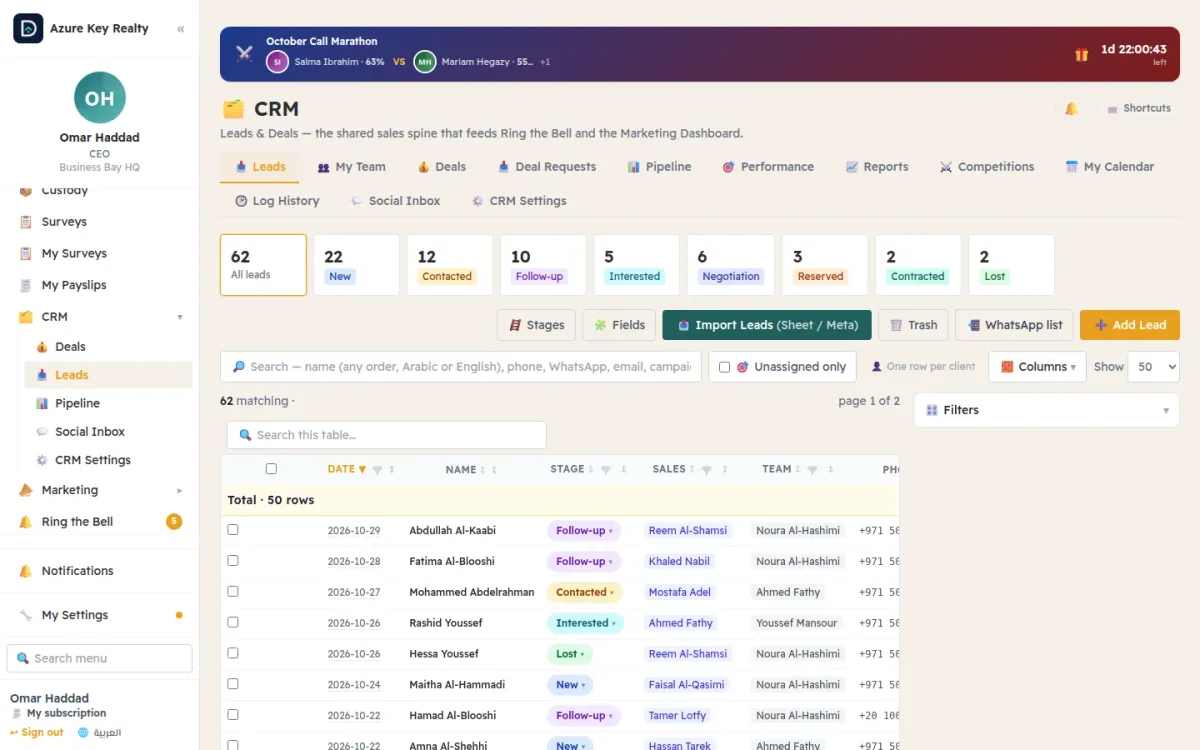
- Source. Where the enquiry came from: a Meta ad, a portal, a referral, a walk-in, a WhatsApp message. Sources differ a great deal in how often they produce buyers.
- Replies. Whether the lead answers messages, how quickly, and how long the replies are.
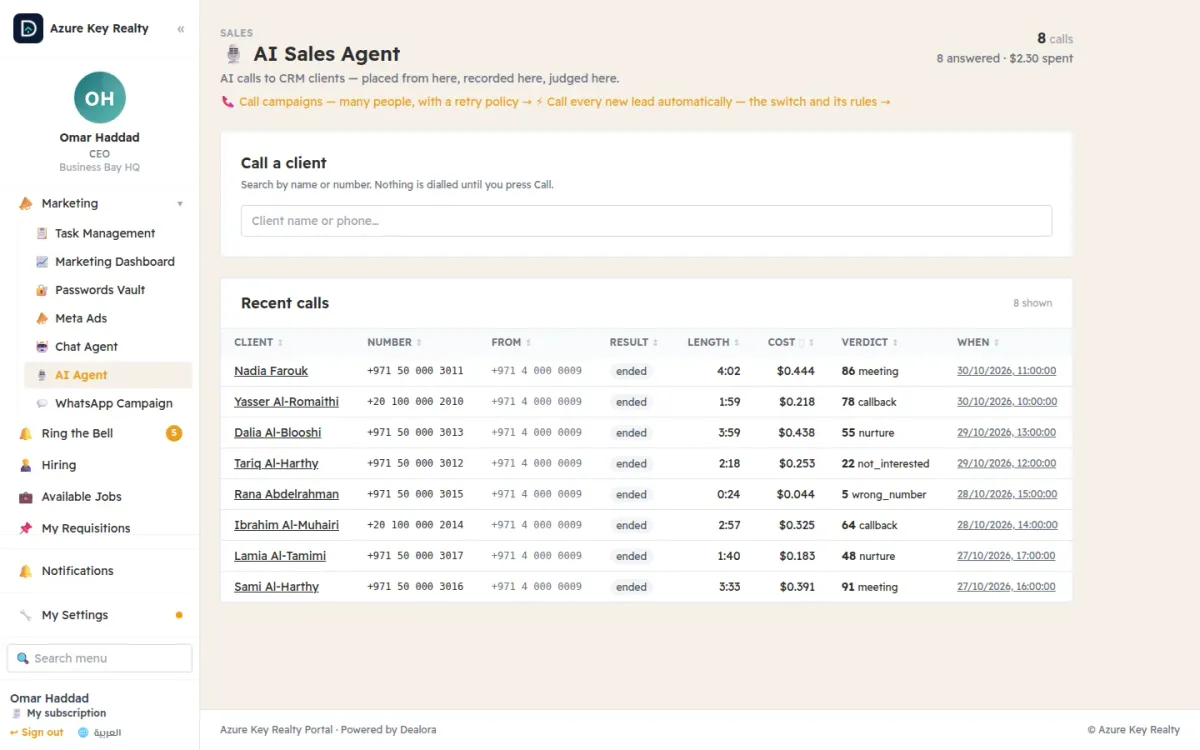
- Call outcomes. Whether calls were answered, how long they lasted and what the salesperson or the AI recorded as the result.
- Budget answers. Whether the lead gave a budget, whether it fits the inventory and whether payment method and timeline were stated.
- Activity in the CRM. Viewings booked, brochures sent, notes added, stage changes and days since the last contact.
These lead score signals are only readable if someone recorded them. A call that was never logged, or a budget the salesperson heard but never typed in, does not exist for the model. That is why scoring depends on a CRM that holds leads, clients, deals, the pipeline and sources in one place.
Reply speed as a signal
Speed to lead is the time from a lead's first enquiry to the first meaningful reply. A meaningful reply is a live conversation, a qualified reply or a booking, not an automatic acknowledgment. Calculate it per lead and take the median.
A 2011 Harvard Business Review study of 1.25 million sales leads across 42 companies found that contacting a lead within an hour made a company nearly seven times more likely to qualify it than contacting it one hour later. Treat it as a reason to measure your own response time, not as a promise. Dealora has a practical guide to setting a speed to lead real estate reply standard your team can enforce.
How much data a scoring model needs
Scoring on a few dozen deals overfits and misleads: the model memorizes accidents, such as one salesperson who happened to close three leads from the same ad. Vendors set different minimums for training data, so ask in writing what yours requires and what it does when you fall short.
A small team without that history is better advised to start with rules-based scoring. That means points you set yourself: a budget that fits earns points, an answered call earns points, thirty days of silence removes points. Rules are easy to explain to a salesperson, and the closed deals you collect while using them become the training data for a model later.
Where the score sits inside CRM statuses and follow-up rules
The score does not replace the pipeline. A stage tells you where the lead is in the buying process; the score estimates how likely it is to close. The stages give you the statuses, and the score decides how fast and by whom the next step happens.
A simple set of follow-up rules might look like this. The bands are an example to adapt, not a standard.
| Score band | What it suggests | Follow-up rule |
|---|---|---|
| High | Looks like leads that closed | Senior salesperson calls first, same working day |
| Middle | Mixed signals | Standard follow-up sequence, review after the first call |
| Low | Looks like leads that did not close | Automated nurture, but a person can lift it at any time |
| Unscored | Key data missing | A person asks the missing questions before any band is assigned |
The "unscored" row matters. A lead with an empty budget field should not quietly receive a low score, because the model may be reading a gap in your records rather than a weak buyer.
Where AI agents fit
Dealora, the real estate ERP Keys of Success built and runs, keeps leads, clients, deals, the pipeline, sources and reports in its real estate CRM with sources and pipeline reports. Its AI Sales Agent makes phone calls to clients and gives you the recording and a verdict on each call. That recording lets a manager listen and confirm the verdict before it shapes how the lead is handled. Calls cost by usage.
The Chat Agent answers customers on Instagram, Messenger, WhatsApp and TikTok from the company's Knowledge and sends only customers to the CRM. It works only with the AI Sales Agent add-on. Both agents produce the call and chat evidence that a scoring process feeds on, which makes them a source of signals you can audit. You can read more about the whole portal on the Dealora product page.
How to audit AI lead scoring in real estate in 60-90 days
An audit does not need a data scientist. It needs a spreadsheet export from the CRM and a few hours from a sales manager.
- Freeze the scores. Record each lead's score and band on the day it was assigned, so later edits do not rewrite history.
- Wait 60-90 days. Property decisions are slow. Auditing after two weeks mostly measures how many leads are still open.
- Compare scores with outcomes. Group leads by band and count closed, lost and open in each. High bands should close clearly more often than low bands. If they do not, the score is not telling you anything yet.
- Spot-check a sample. Pull around twenty leads at random across bands and read the notes, listen to calls and ask the salesperson whether the score made sense. Look especially at high scores that went nowhere and low scores that closed.
- Compare by source. Split the same results by lead source. If one source is always scored low, check whether those leads really close less often or whether the model simply has little history for that source.
- Write the findings down. Note what you will change: the bands, the data you collect, or the vendor.
Step 5 needs reliable source records, and the cost side matters too. A source that scores low might still be cheap and worth a different follow-up approach. Dealora's Marketing Dashboard follows spend to leads to sales, with cost per lead and return on ad spend, so you can read each source's score results next to what it costs.
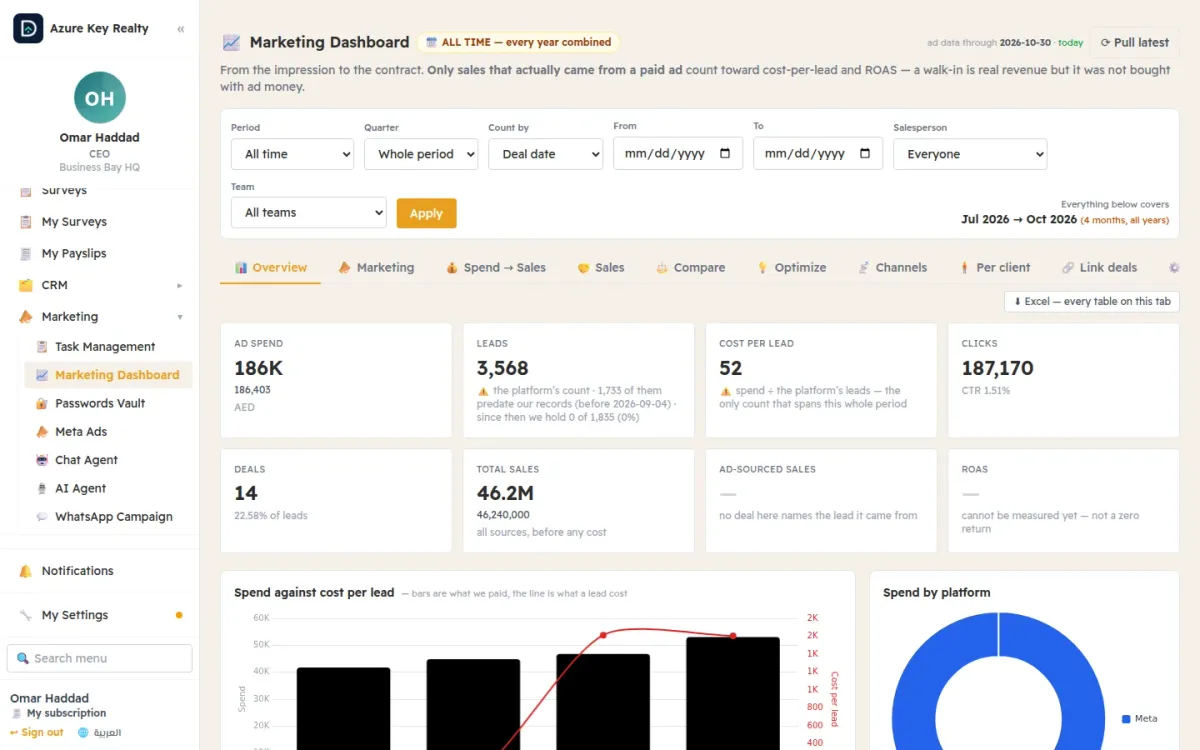
To keep the source field honest in the first place, see how to track leads from Meta ads to closed deals.
Bias, over-reliance and the human override
The NIST AI Risk Management Framework (AI RMF 1.0, January 2023) is voluntary guidance that lists "fair, with harmful bias managed" among the characteristics of trustworthy AI. It names three kinds of bias to manage: systemic, computational and statistical, and human-cognitive. Each can occur without any discriminatory intent, and systemic bias can sit in the datasets themselves.
In a brokerage that can look ordinary. If most of your past clients came through one channel or one nationality of buyer, the model learns that profile as "good" and ranks everyone else lower. The source comparison in step 5 catches part of this. A manager who reads the sample with fresh eyes catches more.
NIST also flags over-reliance, where staff keep trusting automated outputs even when warning signs are present, and notes that human-AI interaction can amplify human biases. A salesperson who skips every low-scored lead is a case in point. Build in these controls:
- Define who reviews scores and who may override them. NIST's MAP 3.5 says human oversight processes should be defined, assessed and documented, and GOVERN 3.2 calls for defined roles and responsibilities.
- Let any salesperson raise a lead's priority, and log the reason.
- Keep histories and audit logs, as NIST Measure 2.8 advises, so people can review possible sources of error or bias later.
- Review override reasons monthly. A pattern of overrides on the same source or lead type is a finding about the model.
Consent and privacy when scoring leads in Egypt
Scoring processes personal data, so it falls under data protection rules. Egypt's Personal Data Protection Law No. 151 of 2020, issued on 13 July 2020 and in force since October 2020, prohibits processing personal data without the data subject's explicit consent unless the law allows it. It also gives people the right to withdraw prior consent. The Personal Data Protection Center is the regulator, and executive regulations were issued in 2025.
The law also requires personal data to be collected for specific, legitimate purposes and processed only in line with them. Check that your lead forms and WhatsApp opt-ins describe scoring as a use of the data. Keep your own human review of scores as an internal control, whatever the law in each market requires. If you operate in other countries, the rules differ, so check them with a lawyer for each market.
A practical next step
Export the last 90 days of leads from your CRM with source, stage and outcome. If most records are missing a source or a result, fix that first, because no score will compensate. If the data is sound, start with simple rules-based bands, audit them against closed deals, and move to a model when you have the history for it.
If you want help connecting scoring, assistants and follow-ups to the tools your team already uses, Keys of Success offers AI integration services that start with one repeated task, test with real Arabic and English messages and keep a person reviewing.
Sources
Frequently asked
What is AI lead scoring in real estate?
It is a number attached to each lead that estimates how likely the lead is to become a client. A model learns from past leads that closed and past leads that did not, then scores each new lead by how closely it resembles the winners. The score is typically 0 to 100.
How many closed deals do I need before AI scoring is reliable?
It varies by vendor, so ask yours for its minimum in writing. Scoring on a few dozen deals overfits and misleads. A small team without that history is better off starting with simple rules-based scoring and moving to a model later.
How do I check whether my lead scores are accurate?
Wait 60-90 days, then compare each lead's score with what happened: closed, lost or still open. High scores should close more often than low scores. Also spot-check a sample of leads by hand and compare results by source to catch bias.
Can AI lead scoring be biased?
Yes, and without anyone intending it. NIST names systemic, computational and statistical, and human-cognitive bias, and notes that systemic bias can sit in the datasets themselves. A model trained on one strong source may rank leads from other sources lower simply because there was less history.
Should a person be able to override the score?
Yes. Define who reviews scores, who may override them, and log each override with a reason. NIST guidance calls for defined human oversight roles and for keeping audit logs. Whatever each country's data law requires, a logged human review is your own internal control.
Does a lead score replace CRM stages?
No. The stage says where the lead is in the buying process. The score estimates how likely it is to close. Use both: stage decides the next step, and the score decides how quickly and by whom that step is handled.
Related

Read next
- Real Estate Drip Campaign: Build a Follow-Up Sequence A step-by-step build of a real estate drip campaign for new property leads: the trigger, five messages over 14
- All in One vs Separate Real Estate Software: How to Decide Five apps for CRM, WhatsApp, ad reports, HR and files cost a brokerage hours of re-typing and lost lead histor
- Lead to Deal Conversion Rate: How to Calculate It by Stage A step-by-step method to calculate your lead to deal conversion rate: fix the counting rules, follow one cohor
- AI to Human Handoff in Sales: 8 Triggers for a Brokerage Eight concrete triggers for passing a chat from an AI agent to a salesperson, plus how to assign it with conte