
AI to Human Handoff in Sales: 8 Triggers for a Brokerage
By Keys of Success Written Published Reviewed by Ali Darwish 9 min read
Eight concrete triggers for passing a chat from an AI agent to a salesperson, plus how to assign it with context, a reply-time standard and a weekly review.

An AI to human handoff in sales should fire on eight triggers: buying intent, budget and unit questions, a viewing request, price negotiation, a complaint, repeated misunderstanding, a client asking for a person, and a question outside the company Knowledge. Assign the chat to one named salesperson with context, and set a reply-time standard.
An AI to human handoff in sales works when the bot knows exactly which moments belong to a salesperson, and the salesperson knows a chat is theirs the second it moves. For a brokerage, eight triggers cover those moments: buying intent, budget and unit questions, a viewing request, price negotiation, a complaint, repeated misunderstanding, a client asking for a person, and a question outside the company's own information. The rest of the work is assigning the chat with context, holding a reply-time standard, and reviewing the handoffs every week.
What the bot owns and what your team owns
A chatbot to human handoff is a division of labor. The bot answers the repeatable questions at any hour: where a project is, what the handover stage is, which payment plans exist, what the next step is. People take everything that needs judgment, a relationship or a commitment.
Dealora's Chat Agent follows that split. It answers customers on Instagram, Messenger, WhatsApp and TikTok from the company Knowledge, and it sends only customers to the CRM, so the team's pipeline is not filled with passing questions. It is included from the Growth plan, it is charged by use, and it works only together with two things: the AI Sales Agent add-on and the company's own Meta connection (its Facebook page, Instagram and WhatsApp Business number). Dealora is sold to real estate companies in Egypt, Saudi Arabia and the United Arab Emirates, and Keys of Success built it and runs it.
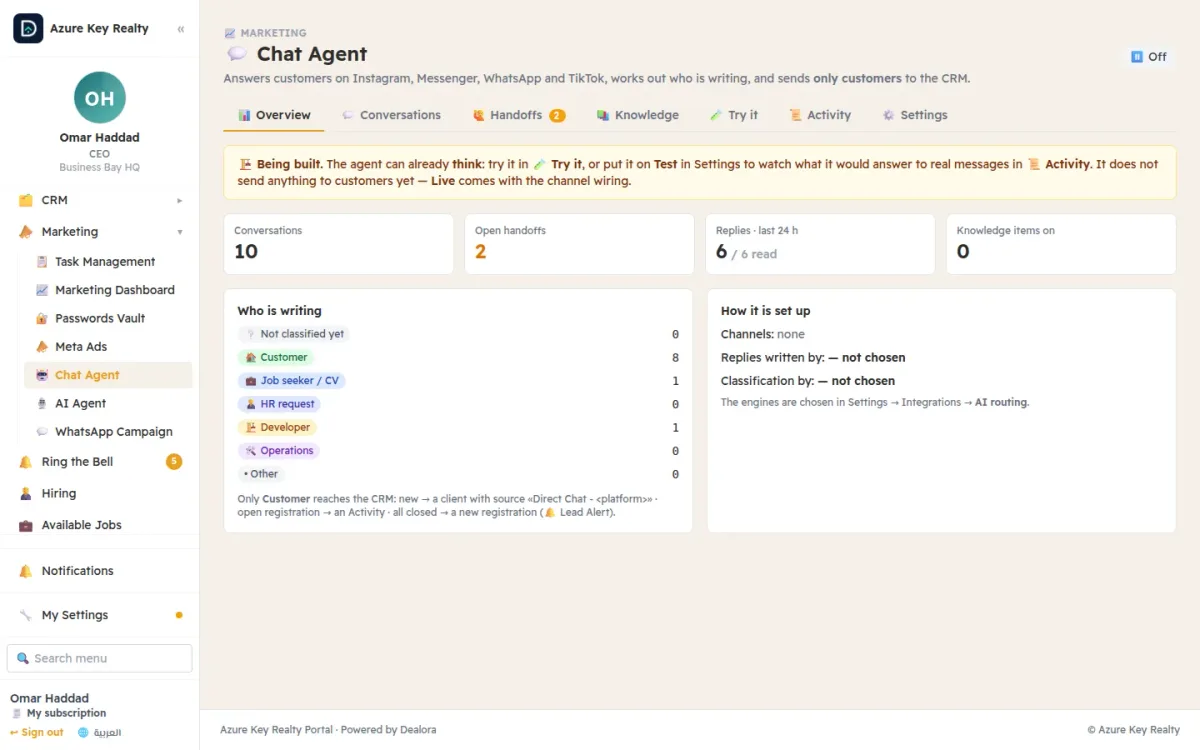
The rules below are written so they work with any setup, but they are easiest to enforce when the handoff, the owner and the CRM record sit in one system. For the channel side, the 6-step setup for an AI agent on Instagram and TikTok messages covers what to prepare first.
Eight triggers for an AI to human handoff in sales
When should a bot transfer to a human agent? Write the answer as AI agent handoff rules your whole team can read in a minute. Each one names a signal in the client's message, not a feeling.
- Buying intent. The client asks what the next step is, whether a unit is still available, how to reserve, or how to pay. The bot stops qualifying and passes the chat. Signals like these are what AI lead scoring in real estate reads, so the same list can feed both.
- Budget and unit questions. General project information is bot territory. The moment a budget is tied to a specific unit, floor, view or payment plan ("what can I get for this amount?"), a salesperson should answer. The bot can ask the opening questions from 8 real estate lead qualification questions; the person asks the rest.
- A viewing request. Any message asking to visit, see a unit or meet. The salesperson owns the calendar and the follow-up, so the chat goes over at once, with the preferred day if the client gave one.
- Price negotiation. Requests for a discount, a better price, a different payment schedule or a comparison with another developer. A bot should never concede or promise anything on price.
- A complaint. A delay, a broken promise, a document problem, an angry tone. Hand over immediately and alert the team leader as well as the salesperson. A scripted apology makes it worse.
- Repeated misunderstanding. Two failed answers in a row: the client rephrases the same question, or writes that the reply missed the point. Two is a policy choice, not a platform setting; adjust it after your first weekly reviews.
- The client asks for a person. "Can I talk to someone?" is a trigger in any wording or language. Do not try to keep the client with the bot, and do not ask them to explain again first.
- A question outside the company Knowledge. If the answer is not in the information you gave the agent, it should say so and hand over, not guess. The question also goes on a list, because it shows what the Knowledge is missing.
Two triggers deserve extra care. Complaints should never wait in a general queue, and the "outside the Knowledge" rule only works if the agent is allowed to admit it does not know. A bot that always produces an answer is the one that gets a brokerage in trouble over a wrong handover date or payment term.
How to hand over a chat to a salesperson with context
A handoff that arrives as a bare notification wastes the first minute of the person's reply, and the client feels it. Pass these five things with every chat:
- the trigger that fired (for example, "viewing request");
- the project or unit the client asked about;
- anything the client said about budget, timing or purpose;
- the channel the conversation is on;
- what the bot already answered, so the salesperson does not repeat it.
Then assign it to one named person, not a group. A shared queue where "someone will pick it up" is where chats go cold. If the client already exists in the Dealora CRM, the chat should go to the salesperson who owns that client; new clients go to the next person under your distribution rules. The sister article on real estate lead distribution rules, time limits and reassignment sets those rules out, including what happens when the first person does not respond.
Continue the chat in the Social Inbox
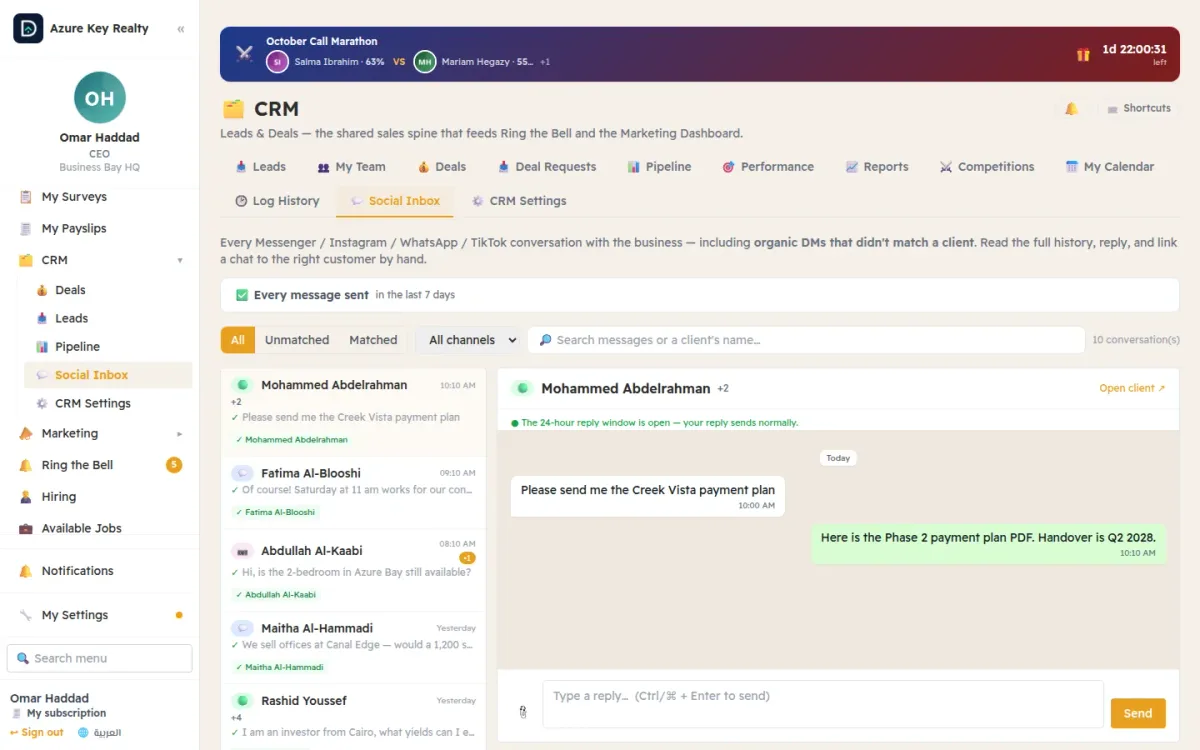
The salesperson then continues in the same thread. On Growth and above, the Social Inbox brings Facebook, Instagram and WhatsApp messages into the CRM, and like the Chat Agent it needs the company's own Meta connection. Whatever tool you use, the rule is the same: the person answers where the client wrote, and the client is never asked to move to another channel just because the bot is finished.
A reply-time standard after the handoff
A handoff trigger without a deadline is only a notification. Write a standard by trigger and print it where the team sees it. The numbers below are examples to adjust to your team size and working hours, not benchmarks.
| Trigger | Example reply target (working hours) | Who takes it |
|---|---|---|
| Buying intent | 5 minutes | Assigned salesperson |
| Viewing request | 5 minutes | Assigned salesperson |
| Client asks for a person | 5 minutes | Assigned salesperson |
| Complaint | 5 minutes | Salesperson and team leader |
| Repeated misunderstanding | 10 minutes | Assigned salesperson |
| Budget and unit questions | 15 minutes | Assigned salesperson |
| Price negotiation | 15 minutes | Salesperson, with a manager if the discount is theirs to approve |
| Outside the Knowledge | Same shift | Salesperson, then the Knowledge owner |
After hours, the target is the first thing the next working morning, and a named person must be on the hook for it. The article on a speed to lead reply standard you can enforce shows how to measure it and what to do when the standard is missed.
What Meta's messaging windows mean for the handoff
The reply standard is not only a service promise. On the channels the Chat Agent covers, Meta's rules put a clock on what a person can send.
- WhatsApp. When a client messages or calls, a 24-hour customer service window opens, and it resets each time the client writes or calls again. Inside the window a business can send free-form (non-template) service messages. Once it closes, only a pre-approved template gets through. A chat handed over late in the day needs a reply before the window ends.
- WhatsApp charges. Each business phone number has a free tier of 1,000 delivered service messages a month. Meta has charged for service messages beyond that since 1 October 2026; they were free from November 2024 to 30 September 2026. Unused free messages do not roll over, messages the client sends stay free, and the rules can change, so check Meta's current WhatsApp pricing page.
- Click-to-WhatsApp ads. If a client messages from one of these ads and the business replies within the 24-hour window, a free entry point window opens that may last up to 7 days, with marketing, utility, authentication and service messages not charged. How long it lasts varies, so a fast first reply matters for ad leads.
- Messenger. A business can only message someone who started the conversation (the same applies on Instagram). Past the standard 24-hour window, the Human Agent tag lets a real person reply manually within 7 days, for issues that cannot be solved in 24 hours, such as ones that arrive outside business hours. Automated messages are a disallowed use, and the app must be approved through Meta's app review before it uses the tag.
The practical result: after a handoff, the reply must come from a person, and it must come inside the window. The WhatsApp Business API chatbot guide explains the template side in more detail.
What to review every week
Handoff rules drift. Products launch, prices change, clients write differently on TikTok than on WhatsApp. Spend thirty minutes a week with the team leader and the person who maintains the Knowledge, and check six things:
- Handoffs by trigger. Which of the eight fired most, and on which channel.
- Time to first human reply. Per trigger, against the standard in your table. Name the chats that missed it.
- Unnecessary handoffs. Chats the bot could have answered. The fix is usually a missing answer in the Knowledge.
- Missed handoffs. Chats where the client asked for a person, complained or asked for a viewing and the bot kept replying. Tighten that rule first.
- Questions outside the Knowledge. Turn the repeated ones into answers, and send questions that need a decision to the manager.
- Outcomes. What happened to handed-over chats in the CRM: viewing booked, offer sent, lost, no reply.
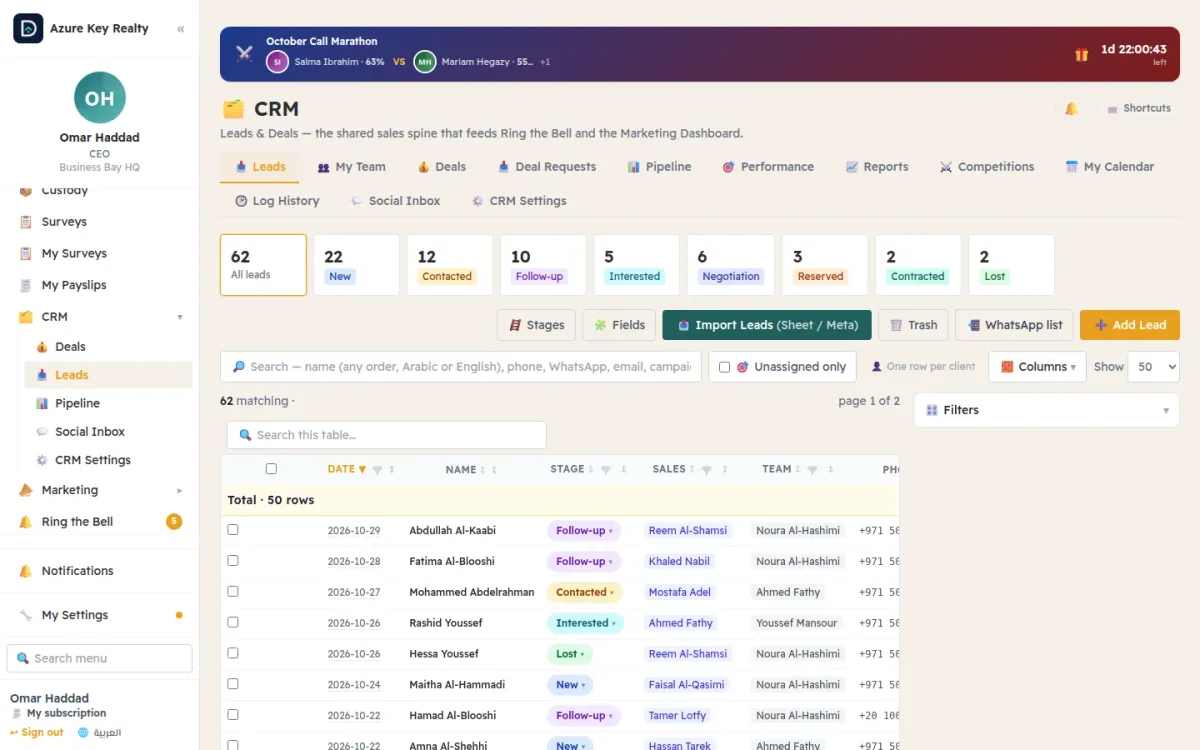
The CRM list, filtered by salesperson and stage, makes the last check quick. If viewings from handoffs stay low for one salesperson, the problem is usually the reply time or the follow-up, not the trigger.
Start with the CRM, add the Chat Agent when the rules are written
The rules above cost nothing to write down, so write them before you switch anything on. The free 3-month trial is on the Starter plan and holds Employees, CRM, Developers & Projects, Projects Map and the Developer Sales index (no data export). You can build your distribution, stages and follow-up there, and create a free Dealora account to begin.
The Chat Agent is a Growth plan module, and it needs the AI Sales Agent add-on, a monthly subscription plus the calls by usage, along with your Meta connection. The AI Sales Agent also places AI phone calls to clients, with the recording and a verdict on each call. To confirm plans and add-ons for your team, talk with the Dealora team through the contact page of the Dealora site.
Sources
Frequently asked
When should a bot transfer to a human agent?
A bot should pass the chat when the client shows buying intent, asks about budget against a specific unit, requests a viewing, starts to negotiate price, complains, keeps rephrasing the same question, asks for a person, or asks something outside the company Knowledge. Each is a moment where a salesperson adds more than a scripted answer.
How many failed answers should a chatbot allow before handing over?
Two is a sensible rule for a brokerage: if the client rephrases the same question or says the answer missed the point twice, the chat goes to a person. The number is your own policy, not a platform setting, so review it weekly against the chats that were handed over.
What does the Dealora Chat Agent need to work?
The Chat Agent works only with the AI Sales Agent add-on and the company's own Meta connection: its Facebook page, Instagram and WhatsApp Business number. It is included from the Growth plan, and it is charged by use as well. It answers from the company Knowledge and sends only customers to the CRM.
How fast should a salesperson reply after a handoff?
Set a written standard by trigger. A common approach is a few minutes in working hours for buying intent, viewings, complaints and requests for a person, and a longer limit for questions outside the Knowledge. After hours, the first reply goes out before the WhatsApp 24-hour window closes.
Can a salesperson reply on WhatsApp after the 24-hour window closes?
Not with a free-form message. The 24-hour customer service window restarts each time the client messages or calls, and once it closes only a pre-approved template can be sent. That is why a handed-over chat needs an owner and a reply deadline, not just a notification.
Related
Read next
- AI Agent for Instagram and TikTok Messages: A 6-Step Setup An AI agent gives accurate property answers only when its Knowledge is current, its limits are written down an
- Real Estate Drip Campaign: Build a Follow-Up Sequence A step-by-step build of a real estate drip campaign for new property leads: the trigger, five messages over 14
- All in One vs Separate Real Estate Software: How to Decide Five apps for CRM, WhatsApp, ad reports, HR and files cost a brokerage hours of re-typing and lost lead histor
- Lead to Deal Conversion Rate: How to Calculate It by Stage A step-by-step method to calculate your lead to deal conversion rate: fix the counting rules, follow one cohor