
CRM Software in 2027: How to Choose the Best Arabic CRM in Egypt
By Keys of Success team Published Updated Reviewed by Ali Darwish 6 min read
How to choose the best Arabic CRM software in Egypt for 2027: the features that matter, ready-made vs custom vs industry CRMs, and a short test before you sign.
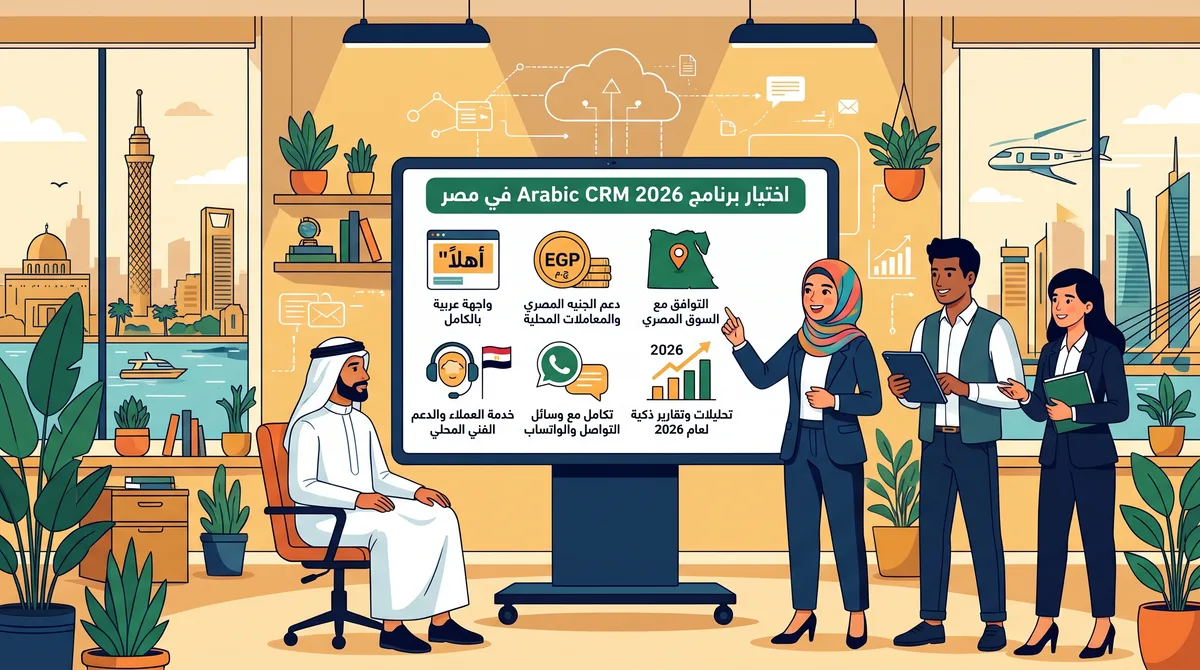
Good CRM software for Egyptian and Gulf companies today has a true right-to-left Arabic interface, WhatsApp and social messages linked to each client, lead-source tracking, permissions, a usable mobile app and full data export. Test it with one real sales team before signing.
The best Arabic CRM software in Egypt for 2027 is the one your sales team will open every day: a full Arabic right-to-left interface, WhatsApp and social messages linked to each client, a working mobile app, clear pipeline reports and data you can export. Good CRM software in Egypt fits your existing sales steps instead of forcing new ones.
What CRM software does, in plain terms
A CRM (customer relationship management system) is the one place where every client, every lead and every deal lives. It records who contacted you, from which source, what they asked for, who on your team owns them, what was said on the last call and what the next step is.
Without it, that information sits in salespeople's phones, personal WhatsApp chats and a shared spreadsheet that nobody fully trusts. When a salesperson leaves, the clients leave with them. A manager who wants to know why last month's ads produced few sales has to ask around instead of opening a report.
What changed for CRM buyers recently
Three things now separate a useful CRM from a contact list. First, conversations: customers in Egypt and the Gulf talk to companies on WhatsApp, Facebook and Instagram, so a CRM that cannot show those messages next to the client record misses most of the story. Second, AI features such as call summaries, follow-up reminders and lead scoring are now built into many systems, and they only work when the data underneath is clean. Third, teams work from their phones, so the mobile experience matters as much as the desktop one.
What to look for in Arabic CRM software in Egypt
- Real Arabic, not a translated menu. Right-to-left layout everywhere, Arabic search that finds “محمد” and “Mohamed” as the same client, and reports that print correctly in Arabic.
- Both languages. Many teams in Cairo and Dubai switch between Arabic and English during the day. Each user should pick their own language.
- Messaging inside the CRM. WhatsApp and social messages linked to the client record, so nobody has to forward screenshots.
- Lead sources and ad tracking. Every lead tagged with the campaign or channel it came from, so you can compare cost and results by source.
- A pipeline that matches your stages. Your own steps, from new lead to closed deal, with reasons recorded when a deal is lost.
- Permissions. Salespeople see their own clients, team leaders see their team, management sees everything.
- A usable mobile app. Logging a call or a meeting should take seconds, not a laptop.
- Your data stays yours. Full export at any time, and a clear answer on where the data is hosted.
Ready-made, custom-built or industry-specific CRM
There are three routes, and the right one depends on how standard your sales process is. The best Arabic CRM software in Egypt for one company can be the wrong choice for another.
| Route | Works well when | Watch out for |
|---|---|---|
| Ready-made general CRM | Your sales process is close to the standard lead, deal, invoice flow | Weak Arabic, features you pay for and never use, extra tools needed for WhatsApp |
| Custom-built CRM | Your process is unusual, or the CRM must connect to internal systems | Needs a clear scope and a development partner who stays after launch |
| Industry-specific CRM | A product already exists for your sector, such as real estate | Check that it covers your exact workflow and grows with the team |
If you are comparing options right now, ask Keys of Success for a free CRM consultation. We will look at your sales steps and tell you which route fits before you spend on licences.
How to choose the best Arabic CRM software in Egypt: a short test
- Write down your sales steps. From the first message to the signed deal, with who does what at each step.
- List your must-haves. Use the checklist above and mark each item as required or nice to have.
- Shortlist two or three options. One of each route if you are unsure.
- Run a real trial. Put one sales team on it for two weeks with real leads, not demo data.
- Ask the salespeople. If they keep going back to WhatsApp and paper, the CRM will fail no matter how good the reports look.
- Check the exit. Make sure you can export everything before you import anything.
The best Arabic CRM software in Egypt is rarely the one with the longest feature list. It is the one that passes this test with your own team.
Mistakes companies make with a new CRM
- Buying for the manager, not the salesperson. Reports depend on data that salespeople enter. If entry is slow, the reports stay empty.
- Importing old mess. Clean duplicates and fix phone numbers before migration, not after.
- Too many required fields. Ask for what you will use. Every extra field is a reason to skip the CRM.
- No owner. One person should own the setup, the training and the weekly check on data quality.
- Launching to everyone at once. Start with one team, fix the setup based on their notes, then roll it out.
Who needs a CRM now, and who can wait
- Needs one now: any company with more than a couple of salespeople sharing leads from ads, WhatsApp and referrals.
- Needs one now: managers who cannot see, on any given day, which leads were not followed up.
- Can wait: a one-person business with a few clients a month, where a tidy spreadsheet still works.
- Needs more than a CRM: companies whose bigger pain is HR, attendance and approvals. That is ERP territory.
If you sell real estate, start with Dealora
Real-estate sales have needs a general CRM does not cover: developers, their projects and phases, unit files to send to clients, and a sales team that lives on WhatsApp. For brokers, sales companies and developers, Keys of Success built Dealora, an Arabic CRM for real estate companies, inside a real-estate ERP.
Its CRM covers leads, clients, deals, the pipeline, sources and reports, alongside Developers & Projects, a Projects Map that lets a salesperson send project files to a client, and a Developer Sales index. It runs in Arabic and English, each company gets its own subdomain, and there is a 90-day free trial on the Starter plan. The Growth plan adds a Social Inbox that brings Facebook, Instagram and WhatsApp messages into the CRM. Measured against the checklist above, note that data export starts on the Growth plan, not on Starter, and test how it works on your salespeople's phones during the trial. Our Dealora article on real estate CRM in Egypt walks through it step by step.
When a custom CRM is the better choice
If your business is not real estate and your process does not fit a ready-made system, our custom software development team builds CRMs and internal portals around how your company actually sells, in Arabic and English, connected to the tools you already use. Before you pick a partner, read our guide on choosing a software development company in Egypt.
Bring us your sales steps on one page. Talk to Keys of Success and we will tell you honestly whether a ready-made Arabic CRM, Dealora, or a custom build is the right fit.
Frequently asked
What is CRM software?
CRM (customer relationship management) software is the shared system where a company keeps every lead, client and deal: where each came from, who owns it, every call and message, and the next step. It replaces scattered spreadsheets and personal phones, and it gives managers reports on sources, pipeline and team follow-up.
Is there a free Arabic CRM?
Some CRMs offer free plans or free trials, but free plans often limit users, features or Arabic support. Judge a free option by the same test as a paid one: real right-to-left Arabic, messaging, permissions and full data export. For real estate, Dealora offers a 90-day free trial on its Starter plan; data export starts on its Growth plan.
What are examples of CRM software?
CRMs fall into three groups: general ready-made systems used across many industries, custom-built CRMs designed around one company's process, and industry-specific CRMs made for a sector. Dealora, for example, is a real-estate CRM and ERP for brokers, sales companies and developers in Egypt and the Gulf.
What is the difference between CRM and ERP?
A CRM manages the customer side: leads, clients, deals and sales follow-up. An ERP connects the whole company, including HR, finance, operations and often a CRM module. Many growing companies start with a CRM and move to an ERP when HR, attendance and approvals need to live in the same system.
How long does a custom CRM project take?
It depends on the scope: the number of sales steps, users, integrations such as WhatsApp or ad platforms, and how much data needs cleaning and moving. With Keys of Success, the scope, stages and timeline are agreed in writing before work starts, and one sales team usually goes live first so you see results early.
Related

Read next
- Real Estate Drip Campaign: Build a Follow-Up Sequence A step-by-step build of a real estate drip campaign for new property leads: the trigger, five messages over 14
- How to Get Real Estate Referrals: A Post-Closing Routine Referrals come from a routine, not a favor. Tag every closed deal, schedule follow-ups after handover, ask at
- All in One vs Separate Real Estate Software: How to Decide Five apps for CRM, WhatsApp, ad reports, HR and files cost a brokerage hours of re-typing and lost lead histor
- Lead to Deal Conversion Rate: How to Calculate It by Stage A step-by-step method to calculate your lead to deal conversion rate: fix the counting rules, follow one cohor