
AI Sales Call Analysis: How to Read a Verdict and Act on It
By Keys of Success Published Reviewed by Ali Darwish 10 min read
A recording and a verdict on every call give a sales manager something random spot-checks never could. Here is how to read a verdict, challenge it by listening, and decide from a week of calls.

AI sales call analysis gives every call a recording and a verdict, so a manager reviews all calls instead of a random few. The verdict tells you which calls to listen to first. It does not replace judgment: you listen, confirm or overrule it, then act on patterns in lead quality, script gaps and follow-up.
AI sales call analysis means every call is recorded and given a verdict, so a sales manager can review all of them instead of the three or four that happen to get checked. The verdict tells you where to listen first. It does not tell you what to conclude. This walkthrough shows how to read a verdict, how to challenge it by listening, and what a week of verdicts should change in your team.
What AI sales call analysis gives a manager
A common way to review calls is to sit next to a rep, or to pick a recording at random on a quiet afternoon. The sample is small, and it is often the calls that are easiest to find, not the ones that matter. A deal that quietly went cold after a poor call never reaches you.
With a recording and a verdict on each call, the unit of review changes. You are no longer asking "which call should I check?" You are reading a list of all calls, each with a short judgment attached, and deciding which ones deserve your ears. That is the whole benefit. The software does the sorting; you do the judging.
Why a verdict on every call beats random spot-checks
Spot-checks fail in three predictable ways. They cover too few calls to show a pattern. They are biased toward whatever the reviewer remembers. And they come late, usually after the lead has already moved on or gone silent.
- Coverage: every call has a recording, so a complaint, a lost deal or a strange lead can be checked against what was actually said.
- Consistency: every call gets the same kind of verdict, so you compare like with like across days, sources and scripts.
- Speed: a verdict is available right after the call, so you can still follow up the same day.
This is a sales call quality review you can actually repeat every week, because it no longer depends on one person finding time to listen to a random sample.
How AI analyzes sales calls, and what to ask any vendor
In general terms, how AI analyzes sales calls follows a simple shape: the speech is captured, turned into text, and read against a set of questions, such as whether the client showed interest, objected, or agreed to a next step. The result is a short verdict. Exactly which signals a given product reads, and how it weighs them, differs from one product to the next.
So before you rely on any tool, ask four things:
- Does it keep the recording, so every verdict can be checked by listening?
- Does it work in the language and dialect your clients use? Test it with real Arabic and English calls, not a demo.
- Can you see the verdict next to the call details, such as length and cost, in one list?
- Who sees the recordings, and for how long are they kept?
If a product cannot answer the first question, treat its verdicts as opinions you cannot verify. For real estate teams, call recording is also the simplest way to settle a dispute about what a client was told on price, payment plan or delivery date.
A worked example: Dealora's AI Sales Agent
Dealora, the real estate ERP built and run by Keys of Success, includes the AI Sales Agent. It makes AI phone calls to clients and keeps the recording, with a verdict on each call. The call history lists each client with the call length, the cost and the verdict, so a manager reads one screen instead of hunting through files.
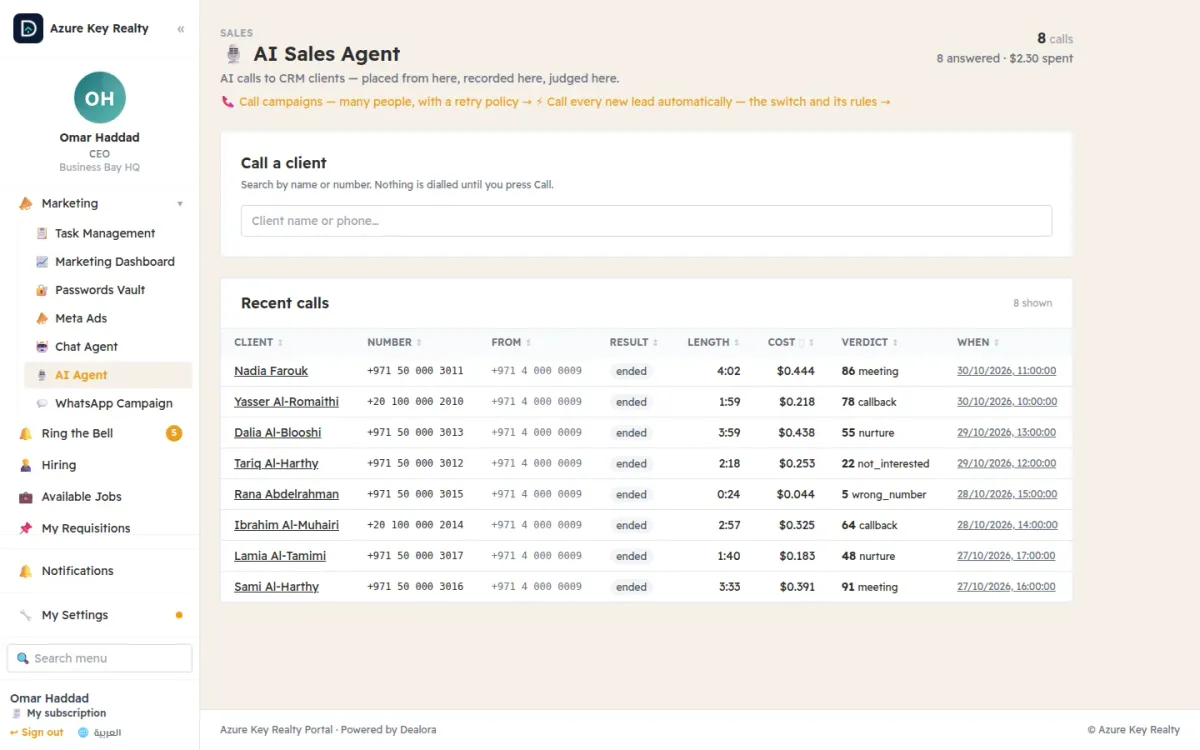
Two details matter for budgeting. Calls are charged by usage, and the AI Sales Agent is an add-on available from the Starter plan, charged as a monthly subscription plus the calls it runs. It is not part of the 3-month free trial, which sits on the Starter plan and holds Employees, CRM, Developers & Projects, Projects Map and the Developer Sales index. Current prices are on the Dealora pricing page.
One boundary to keep in mind: this tool places the calls itself. It suits first contact with new enquiries, the kind of AI calling agent for real estate leads that reaches a client while the interest is fresh. Your human reps' own calls are a separate matter, but the review routine below works the same way for any recorded call.
How to read a verdict and challenge it by listening
A verdict is a prompt to listen. Treat it like a colleague's quick note: useful, usually right about where to look, and not final. This routine takes about ten minutes for a handful of calls.
- Sort first. Start with the calls whose verdict is most positive and those that are most negative. The middle can wait.
- Listen to the opening and the ending. The first thirty seconds show how the client reacted; the last thirty show whether a next step was agreed. You rarely need the full recording to judge.
- Compare the verdict with what you heard. Write one word next to each: agree, partly, or disagree. Keep the tally.
- Check a few the verdict did not flag. If quiet calls hide real interest, the verdicts are missing something, and you need to know that.
- Look at the length and the cost. A very short call and a very long one both deserve a listen, for opposite reasons.
- Act on the call, not on the label. If you overrule a verdict, note why. After two or three weeks your notes show where the tool is reliable for your clients and where it is not.
Do not promise yourself a fixed accuracy rate. Nobody can give you one that holds for your market, your dialects and your scripts. Your own agree-or-disagree tally is the only measure that counts for your team.
What to decide from a week of verdicts
One call tells you about one client. A week of calls tells you about your process. Read the week as a set, and look for three things: lead quality, script gaps and follow-up.
| What you see in the week | What it may mean | What to decide |
|---|---|---|
| One lead source gets weak verdicts again and again | The audience or the ad promise does not match what you sell | Review that source's targeting and message before spending more on it |
| Clients object at the same moment in many calls | The script handles that point badly, or says it too early | Rewrite that part, then compare next week's calls |
| Positive verdicts, but no meeting booked afterward | Follow-up is the weak link, not the call | Set a reply time and an owner for every positive call |
| Many very short calls | Wrong numbers, wrong audience, or an opening that loses people | Check the data first, then the opening line |
| Verdicts you often overrule | The tool misreads your clients or your dialect | Rely on it less for that call type and keep listening |
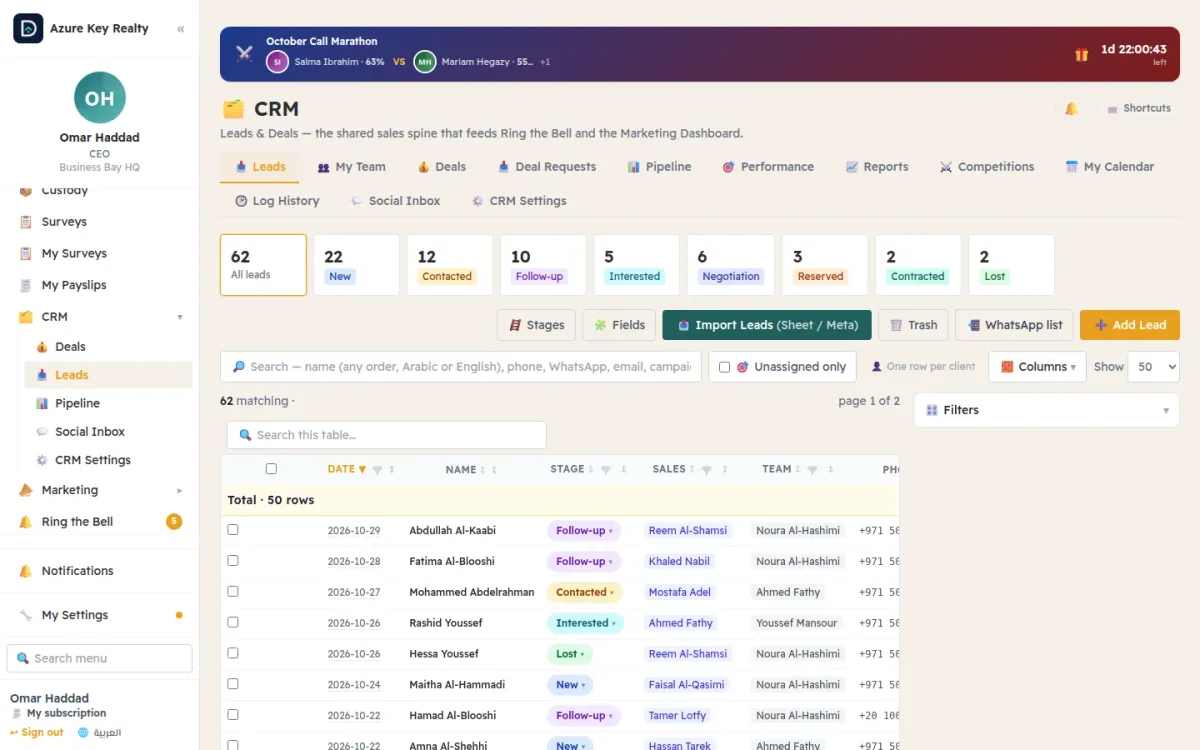
Lead quality is where the weekly review pays most. If one channel keeps producing weak calls, compare it with its cost. A CRM that records the source of each lead lets you see which source the call came from, and the Marketing Dashboard (Growth plan and above) shows cost per lead and return on ad spend next to it.
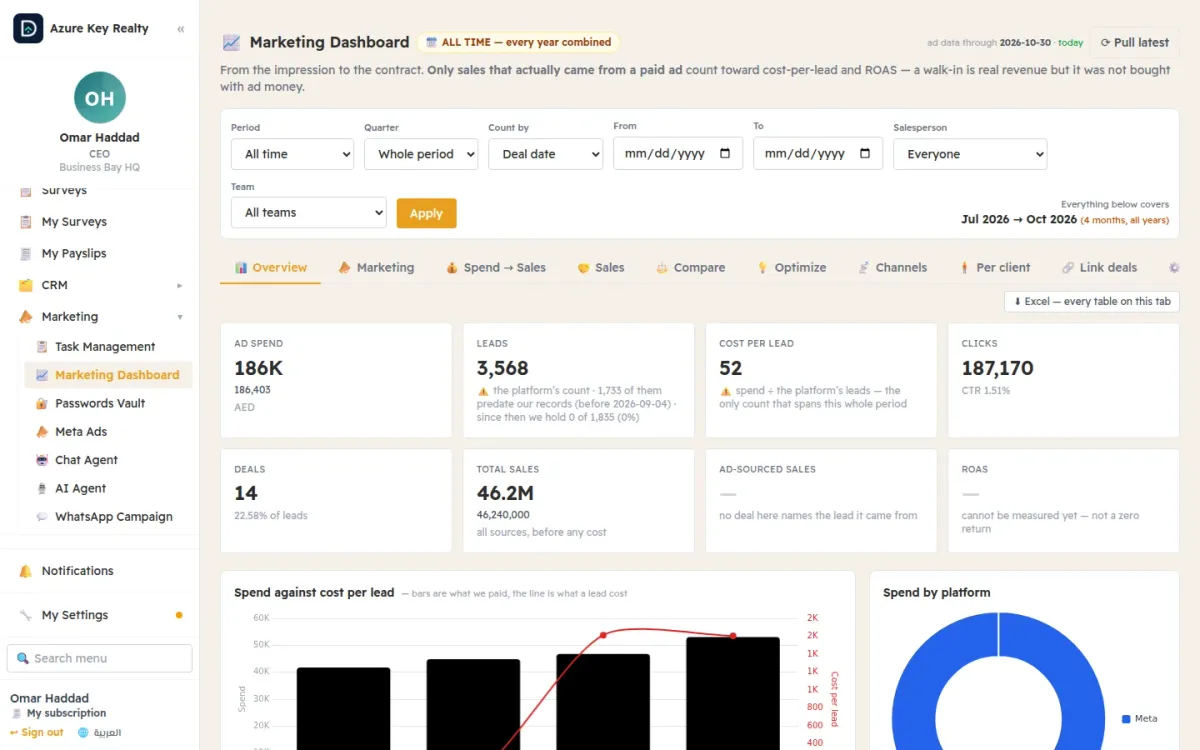
For the lead side, it helps to pair the verdicts with a scoring habit. The article on AI lead scoring in real estate shows what such a score reads and how to audit it. For script gaps, check whether your reps and your AI calls ask the right things before a viewing; the list of real estate lead qualification questions is a good yardstick.
Follow-up is the third decision, and it is the one managers skip. A positive call is worth little if the next message comes two days later. The reply standard in speed to lead in real estate gives a rule you can enforce, and the CRM stage should change the same day the call ends.
Recording consent: settle it before the first call
Call recording for real estate sales touches personal data, and the rules differ by country. Treat this as a checklist to confirm with a lawyer, not as legal advice.
- Egypt: Article 309 bis of the Penal Code punishes recording or transmitting a conversation held by telephone or in a private place without the person's consent, with up to one year in prison. Personal Data Protection Law No. 151 of 2020 prohibits collecting or processing personal data without the data subject's explicit consent, unless the law allows it. The person may withdraw consent and may ask to access, correct, update or delete their data. The Executive Regulations, issued in November 2025, require you to keep a record of the consent, its date and its form, and to state the retention period.
- United Arab Emirates: federal law (the Cybercrimes Law, the Telecommunications Law and the Penal Code) does not permit recording phone conversations without the consent of the parties concerned. The usual way to obtain it is to tell them in advance that the call may be monitored. Under Federal Decree-Law No. 45 of 2021, in force since 2 January 2022, consent is the default basis for processing personal data unless an Article 4 exception applies, you must be able to prove it, and the person can withdraw it at any time. The law does not apply to free zones with their own data law, such as DIFC and ADGM.
- Saudi Arabia: under Article 11 of the Implementing Regulation of the Personal Data Protection Law, consent may be written, verbal or electronic, and must be documented so it can be verified later, for example in a register of the time and the means. The purposes must be explained when consent is requested, with a separate consent for each purpose. The law took effect on 14 September 2023, and the grace period for full compliance ended on 14 September 2024. Administrative fines can reach SAR 5 million.
In practice this means three habits: tell the client at the start of the call that it is recorded, store the proof of consent with the recording, and give your team a way to delete a client's data when asked.
Automated decisions deserve one more note. The UAE law gives people the right to object to decisions based on automated processing, and the Saudi regulation requires explicit consent when decisions rest solely on automated processing of personal data. Keeping a manager between a verdict and any decision about a person is both better practice and the safer position.
Limits to keep in mind
A verdict compresses a conversation into a short judgment, and compression loses things. Sarcasm, a background voice, a client who sounds cold but is simply driving, a joke that lands badly: a machine can read any of these wrongly. Dialect and phone-line quality add more noise.
So use the verdict to decide where to listen, never to decide about a person. Do not rank your reps by verdict alone, and do not discard a lead because of one label. If you want AI built around your own data and workflows beyond calls, the AI integration services from Keys of Success start with one repeated task, test with real Arabic and English messages, and keep a person reviewing the output.
A first week you can run
Pick one lead source and one script. Confirm your consent wording with legal advice and add it to the opening of every call. Run the calls for five working days, then spend an hour on the verdicts: sort, listen to the opening and ending of the extremes, tally your agree-or-disagree notes, and fill in the table above for that week. Make one change to the script or the follow-up rule, and run the same week again.
If you want help deciding whether AI phone calls fit your team, or how to connect them to your CRM, talk to the Keys of Success team and bring one real week of calls as the starting point.
Sources
Frequently asked
What is AI sales call analysis?
It is the practice of having software record a sales call and give a verdict on it, so a manager can review every call rather than a handful. The verdict points to the calls worth hearing first. A person still listens, decides whether the verdict is right, and acts on it.
Can AI replace a sales manager's call review?
No. A verdict is a prompt to listen, not a ruling. The manager checks it against the recording, because tone, context and a client's real intent can be missed. What changes is coverage: every call is available to review, and the manager chooses where to spend listening time.
How does Dealora's AI Sales Agent handle calls?
The AI Sales Agent makes AI phone calls to clients and keeps the recording, with a verdict on each call. It is an add-on from the Starter plan, charged as a monthly subscription plus the cost of the calls it makes. It is not part of the 3-month free trial.
Do I need consent to record sales calls?
Yes, plan for it. Egypt's Penal Code punishes recording a phone conversation without consent, and UAE federal law does not permit recording without the consent of the parties concerned. Saudi rules require documented consent, given separately for each purpose. Take legal advice for your exact setup.
How often should a manager review the verdicts?
Read the verdicts daily or at least every few days, and run a weekly review of patterns. Listen to the calls the verdict flags and to a few it did not, so you can tell whether the verdicts match what you would have concluded.
Related
Read next
- AI Lead Scoring Real Estate: What It Reads and How to Audit It A plain explanation of what an AI lead score reads in a brokerage, plus a 60-90 day audit that compares scores
- Real Estate Drip Campaign: Build a Follow-Up Sequence A step-by-step build of a real estate drip campaign for new property leads: the trigger, five messages over 14
- How to Get Real Estate Referrals: A Post-Closing Routine Referrals come from a routine, not a favor. Tag every closed deal, schedule follow-ups after handover, ask at
- All in One vs Separate Real Estate Software: How to Decide Five apps for CRM, WhatsApp, ad reports, HR and files cost a brokerage hours of re-typing and lost lead histor