
Types of Clients in Real Estate: 6 Buyer Segments and How to Tag Them
By Keys of Success Published Updated Reviewed by Ali Darwish 10 min read
Six buyer segments for brokerages in Egypt and the Gulf: end-user, investor, upgrader, first-time, overseas and bargain hunter. Each comes with its motive, follow-up and CRM fields.

The six main types of clients in real estate are the end-user, the investor, the upgrader, the first-time buyer, the overseas or expat buyer and the cash-ready bargain hunter. Each buys for a different reason, so each needs a different follow-up. Record the segment and the pipeline stage on every lead in your CRM.
The most useful way to group the types of clients in real estate is by motive, not by budget. Six segments are a practical way to sort most of the clients a brokerage in Egypt or the Gulf meets: the end-user, the investor, the upgrader, the first-time buyer, the overseas or expat buyer and the cash-ready bargain hunter. Each asks different questions and responds to a different follow-up. Once the segment is written on the lead, an agent stops sending the same brochure and the same "any update?" message to everyone.
Why real estate client segmentation changes your follow-up
A lead from a Meta ad arrives as a name, a phone number and a project of interest. That tells the agent almost nothing about what the person needs. A family looking for a school-friendly neighborhood and an investor comparing rental yields may both ask "what is the price?", yet the right answer to each is completely different.
Without segmentation, agents default to one script. Some clients feel rushed, others feel ignored, and the manager cannot tell why conversion differs between agents. With segmentation, you can see which segments your campaigns attract, which agents close which segments, and where each type stalls.
Two ideas keep the system simple. The segment says who the client is and why they buy. The stage says where the deal stands now. The segment rarely changes; the stage changes weekly.
Types of clients in real estate: the six segments at a glance
| Segment | Main motive | First thing to record |
|---|---|---|
| End-user | A home to live in | Household size, preferred area, move-in date |
| Investor | Return and resale value | Target return, hold period, number of units wanted |
| Upgrader | A better home than the current one | Current property, sale needed first or not |
| First-time buyer | Own instead of rent | Monthly income range, down payment, mortgage plan |
| Overseas or expat buyer | Family home, holiday home or return investment | Country of residence, ownership eligibility, time zone |
| Cash-ready bargain hunter | The lowest price for quick payment | Cash available, deadline, discount expectation |
The end-user: buying a home to live in
The end-user cares about daily life: the commute, schools, the compound community, service charges and when the keys arrive. Price matters, but fit matters more.
Typical questions: What is the delivery date? What are the finishing specifications? What is nearby? Can I see a finished unit?
Follow-up that suits: Practical content and a site visit. Send the floor plan, a map of the surroundings and the developer's delivery record for the project, then offer a viewing at a time that suits the whole family.
Record in the CRM: household size, preferred areas, budget range, desired move-in date and who else takes part in the decision. In many families the decision maker is not the person who first called.
The investor: buying for return
The investor compares numbers. Payment plan length, expected rental income, resale potential and the developer's reputation matter more than the view from the balcony. Some buy several units, so one investor can be worth several end-users.
Typical questions: What is the payment plan? What does a similar unit rent for? What happens if I want to resell before handover?
Follow-up that suits: Short, factual messages with figures, not adjectives. Offer a comparison of two or three projects and keep the tone professional. Do not oversell returns; an investor who feels pushed will check every claim.
Record in the CRM: number of units wanted, hold period, preferred payment structure, the projects already compared, and whether the person has bought through you before.
The upgrader: moving to a better home
The upgrader already owns a home and wants more space, a better location or a newer compound. Their timeline often depends on selling the current property, which makes them slower but usually well informed.
Typical questions: Can I sell my current place first? How long until handover? What does a larger unit cost in this phase?
Follow-up that suits: Patience, plus a clear timeline that fits their sale. If your brokerage can also list their existing property, say so; it removes the biggest worry in the conversation.
Record in the CRM: the current property and its location, whether it is listed, the sale deadline and the reason for moving.
The first-time buyer: needs guidance more than a pitch
The first-time buyer is excited and anxious in equal parts. They ask many questions, compare often and need the process explained step by step. Financing is usually the real topic, even when the first message is about a unit.
In Egypt, the state-backed mortgage initiatives now run at two rates. Since 15 October 2025, new loans under the low-income initiative carry a declining rate of 8% (up from 3%), and new loans under the middle-income initiative carry a declining 12% (up from 8%); loans granted before that date keep their original rate. Other conditions, such as the repayment term, the share of the price financed and the income limits, vary by bank. Banks and mortgage finance companies had provided EGP 111.131bn to about 723,604 customers under the low- and middle-income housing initiative as of July 2026, per the Social Housing and Mortgage Finance Fund, so the route is well used. Agents should not quote terms from memory; send the client to the bank for the current conditions.
Typical questions: Can I afford this? How much is the down payment? What documents do I need? What if my application is rejected?
Follow-up that suits: A simple checklist, one clear next step at a time and regular, friendly check-ins. Avoid long messages full of jargon.
Record in the CRM: monthly income range, down payment available, whether the client plans a mortgage, which bank they are talking to and the documents still missing.
The overseas or expat buyer: distance changes the sale
Overseas and expat buyers cannot visit easily, live in another time zone and worry about legal rules and trust. They often buy for family reasons, as a holiday home, or as a return investment in their home country.
Ownership rules differ by country, and they change, so an agent should treat the following as orientation and confirm the current position before making promises.
- Egypt: Foreign ownership is governed by Law 230 of 1996, which originally limited a foreign individual to two residential properties of up to 4,000 sqm each. Later decrees eased the unit limit for buyers who pay in foreign currency transferred from abroad. Some areas stay restricted: in Sinai, for example, foreign ownership is banned outside specific zones such as Sharm El-Sheikh and Dahab. Owning property does not automatically grant residency, though qualifying investment may support visa extensions or long-term permits.
- Dubai: The Dubai Land Department lists a 10-year renewable Golden Visa for real estate investors whose purchase value is AED 2 million or more, wholly owned by the investor, in one or more properties. For a mortgaged property, the department asks for a no-objection letter from the bank showing the amount paid. It gives seven to ten business days as the expected completion time.
- Saudi Arabia: The Law of Real Estate Ownership by Non-Saudis was published on 25 July 2025 and entered into force in January 2026. Non-Saudis may acquire rights inside designated zones, and a non-Saudi resident individual may own one residential property for personal use outside those zones. Makkah and Madinah have special rules, with limited rights for Muslim foreign individuals only. Rights count legally once registered in the Real Estate Registry, and the law sets a transfer fee on disposals capped at 5 percent of value, on top of standard taxes.
Typical questions: Am I allowed to buy? Can I pay from abroad? Who handles registration? Can I see the unit on video?
Follow-up that suits: Messages sent at the client's local daytime, a video walkthrough, and a named contact who stays the same throughout. Ask which channel they already use, often WhatsApp, and keep the conversation in one thread.
Record in the CRM: country and city of residence, time zone, preferred channel, eligibility questions answered, and who will sign on their behalf if they cannot travel.
The cash-ready bargain hunter: fast money, firm price
This buyer has funds and wants a discount. They may ask the same question of five brokerages and move quickly when a price fits. Resale units, distressed sales and developer end-of-phase offers appeal to them.
Typical questions: What is the best cash price? Is there a discount for paying in full? How fast can we sign?
Follow-up that suits: Speed and clarity. Reply fast with the cash price on the right units, set a deadline that is real, and do not invent urgency. If the margin is thin, say so early rather than losing days in negotiation.
Record in the CRM: the cash amount available, the maximum price they will accept, their deadline, and the offers you have already sent them.
How to tag clients by segment and stage in a CRM pipeline
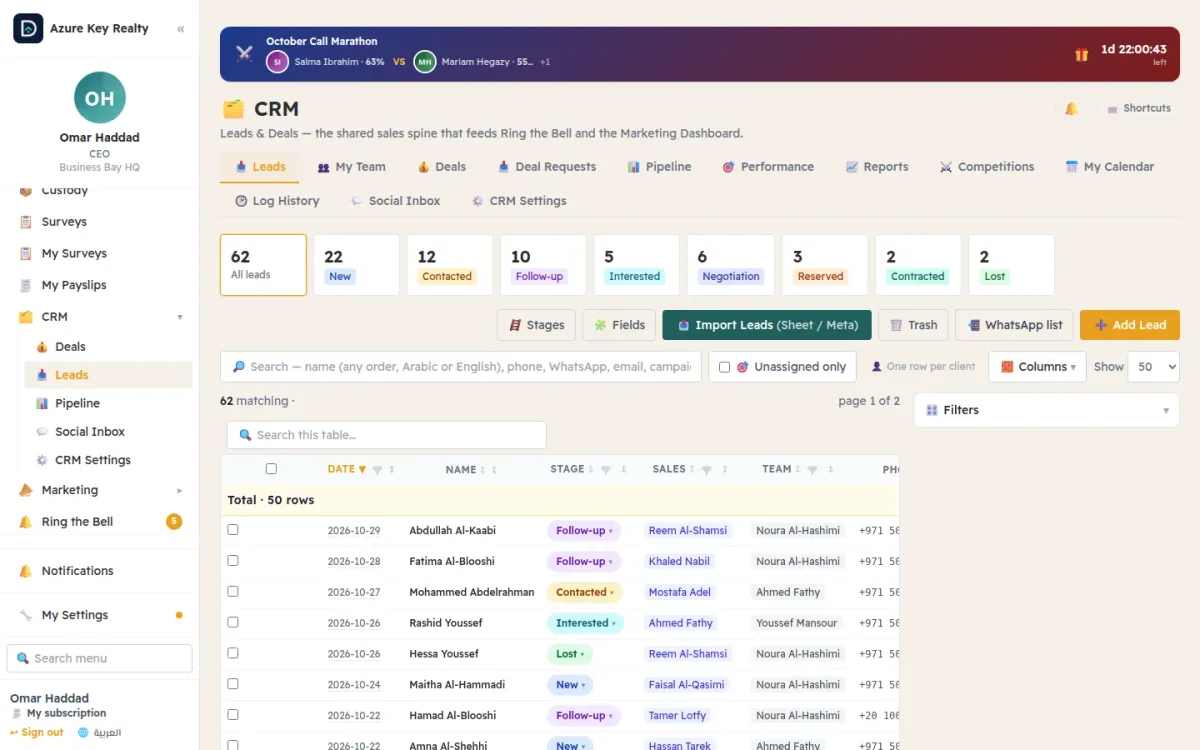
The method below works in any CRM that stores leads, clients and deals, including the CRM module inside Dealora, our real estate ERP. If you are still choosing a system, the real estate CRM comparison and the guide to the best Arabic CRM in Egypt list what to check first.
- Fix the six segment names. Use the same words across the whole team. If one agent writes "investor" and another "investment buyer", reports will split.
- Add a segment field or tag to the lead. Use whichever your CRM offers. Allow one main segment per lead, plus a note if the client sits between two.
- Write three qualifying questions. Who will use the property? How will it be paid for? When do you want to decide? Agents ask them in the first call, and the answers choose the segment.
- Define pipeline stages separately. New lead, contacted, qualified, viewing, negotiation, closed. The real estate sales pipeline stages article explains exit rules and time limits for each.
- Map a follow-up to each segment and stage. A first-time buyer at "qualified" gets the financing checklist; an investor at "qualified" gets the project comparison. Write these as a short table the agents can see.
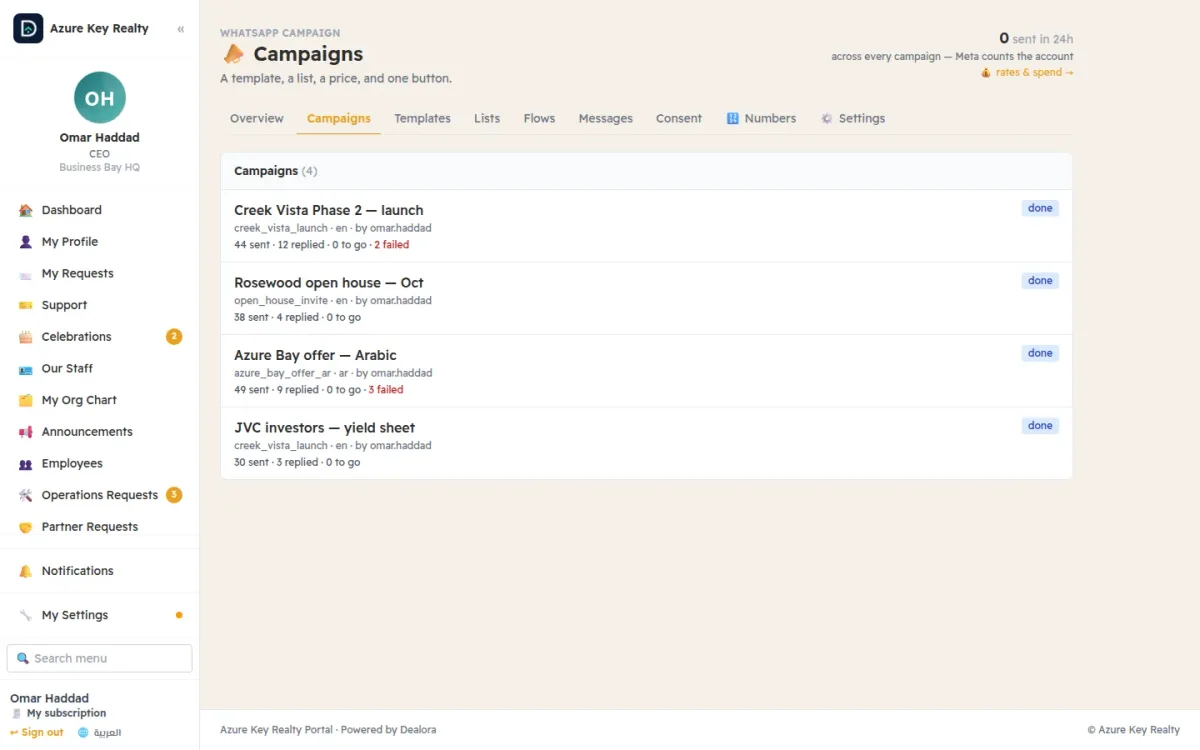
- Bring every channel into one record. Messages from Facebook, Instagram and WhatsApp should sit on the lead, not in agents' phones. The Social Inbox (Growth plan and above) does this inside the CRM.
- Use segments for bulk messages. Send each segment its own approved template through WhatsApp bulk campaigns (Growth plan and above), such as a new-phase notice for investors and a finishing update for end-users.
- Review monthly. Look at leads by segment, stage and source. Move agents toward the segments they close and retire segments that never convert.
Mistakes that make segmentation fail
- Segmenting by budget only. A client with a large budget can be an end-user, an investor or a bargain hunter, and each wants something different.
- Tagging once and never updating. A first-time buyer who bought a flat last year may return as an upgrader. Change the tag when the situation changes.
- Too many segments. Six is plenty. Every extra tag adds cost and makes reporting harder to read.
- Skipping the source. Knowing which campaign brings which segment shows where ad money works. The real estate CRM software keeps the source on each lead alongside the pipeline, so the two can be read together.
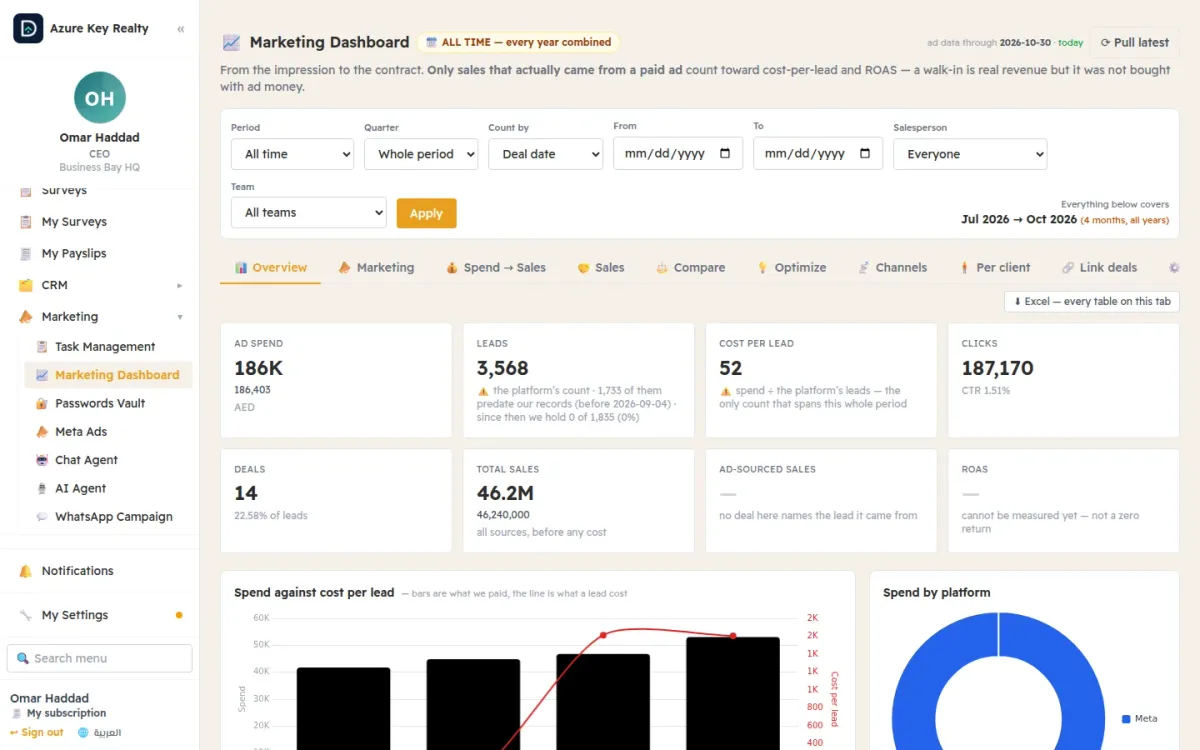
Once the source is on every lead, the Marketing Dashboard in Dealora (Growth plan and above) carries it one step further. It follows spend to leads to sales and shows cost per lead and return on ad spend, so you can see which campaigns bring the segments that actually close.
Where to go from here
Start small. Pick the last 50 leads in your CRM, assign each one a segment by reading the notes, and see which segment dominates and which one converts. That single exercise usually shows where your pitch is mismatched. For the next layer, read how to build a real estate client database so those segments stay clean as the list grows.
If your current system cannot hold a segment field or separate stage from segment, that is a sign it no longer fits how your team sells. Keys of Success builds custom systems around a company's workflow through its software development service, and the team can also advise on whether a ready-made CRM is enough for you.
Sources
- Ahram Online: CBE raises interest rates on real estate financing initiatives (16 Oct 2025)
- Daily News Egypt, citing the Social Housing and Mortgage Finance Fund (Sep 2026)
- Dubai Land Department: Golden Visa for real estate investors
- Saudi Real Estate General Authority (REGA): Law of Real Estate Ownership by Non-Saudis
Frequently asked
What are the main types of clients in real estate?
Six segments are a practical way to sort most of the clients a brokerage in Egypt or the Gulf meets: the end-user who will live in the home, the investor who wants returns, the upgrader moving to a better home, the first-time buyer, the overseas or expat buyer, and the cash-ready bargain hunter. Each has a different motive, so each needs a different pitch.
How do you classify real estate leads?
Ask two or three short questions in the first conversation: who will use the property, how will it be paid for, and when does the client want to decide. Record the answers as a segment on the lead, then track the deal stage separately in the pipeline.
What is the difference between a buyer segment and a pipeline stage?
A segment describes who the client is and why they buy, and it rarely changes. A stage describes where the deal stands today, such as first contact, viewing or negotiation, and it changes often. Keeping both on the lead lets you choose the right message at the right moment.
Can a first-time buyer in Egypt use a mortgage?
Often yes. Egypt's state-backed mortgage initiatives charge a declining 8% for low-income buyers and a declining 12% for middle-income buyers on new loans since 15 October 2025. Terms, financing share and income limits differ by bank and change over time, so the agent should send the client to the bank for the current conditions.
Does buying property give a foreign buyer residency?
Not automatically. In Egypt, ownership does not by itself grant residency, though qualifying investment may support visa extensions or long-term permits. Dubai lists a 10-year Golden Visa for property purchases of AED 2 million or more. Rules vary and change, so confirm with the authority.
Should one agent handle every segment?
They can, but only if the CRM shows the segment on the lead, so each agent sees who the client is before replying. What matters is that the pitch matches the buyer, whoever handles the lead.
Related

Read next
- Real Estate Drip Campaign: Build a Follow-Up Sequence A step-by-step build of a real estate drip campaign for new property leads: the trigger, five messages over 14
- All in One vs Separate Real Estate Software: How to Decide Five apps for CRM, WhatsApp, ad reports, HR and files cost a brokerage hours of re-typing and lost lead histor
- Lead to Deal Conversion Rate: How to Calculate It by Stage A step-by-step method to calculate your lead to deal conversion rate: fix the counting rules, follow one cohor
- Real Estate Buyer Persona Template: 4 Fields and CRM Tags A fill-in persona card for brokerages: four fields (budget, location, purpose, timeline), five worked examples