
Real Estate Buyer Persona Template: 4 Fields and CRM Tags
By Keys of Success Published Reviewed by Ali Darwish 10 min read
A fill-in persona card for brokerages: four fields (budget, location, purpose, timeline), five worked examples, and how to store each persona in the CRM so follow-up and project matching change per buyer.

A real estate buyer persona template is a one-page card with four fields: budget, location, purpose and timeline. Build one card per common buyer from your own closed deals, give each a short tag, and store the tag and the four fields in your CRM so follow-up messages and project suggestions change for each buyer.
A real estate buyer persona template is a one-page card that describes one type of buyer in four fields: budget, location, purpose and timeline. Fill in one card for each common buyer, build it from the deals your brokerage has already closed, and attach it to every lead as a tag in the CRM. Once the tag is there, follow-up messages and project suggestions can change for each buyer instead of every lead getting the same script.
What a buyer persona is in real estate, and what it is not
A buyer persona is a short, named description of a pattern you see again and again: the family buying a first apartment, the investor comparing three launches, the expat choosing a home from abroad. It is not a single customer, and it is not a list of age groups or job titles invented in a meeting.
The difference from a broad segment is that a persona is written to be used. A segment tells you who buyers are. A persona card tells a salesperson what to ask, what to send and which projects to open first. If you want the wider map of buyer groups first, the article on types of clients in real estate and how to tag them covers six segments. This template takes the next step and turns a segment into a card your team fills in and reuses.
The real estate buyer persona template: four fields
Each card has a persona name, four fields and one follow-up rule. Keep the wording short enough to fit in a CRM field.
| Field | What to write | Where to read it from |
|---|---|---|
| Budget | The range the buyer works within and how they pay: cash, installments or a mix. Add the deposit comfort level if it is a deciding factor. | The signed contract and payment plan of closed deals, and the answer to your budget question on the first call |
| Location | The two or three areas or projects they consider, and the one condition that is not negotiable (near work, near schools, on the coast, close to family). | The unit sold, the projects the buyer viewed before it, and the areas they rejected |
| Purpose | Live in, rent out, resell or use as a second home. | The buyer's own words in call notes and chat messages |
| Timeline | The date or event by which the buyer must decide: a lease ending, a school term, a launch deadline, a trip. | The days between first contact and signature in closed deals, and what the buyer said was driving it |
The follow-up rule is one sentence: what the salesperson sends first, and what they never lead with. For a family it may be the monthly installment; for an investor it may be the payment plan and the developer's delivery record. The next sections show filled-in cards.
How to create a buyer persona for real estate from your closed deals
You do not need a survey or outside statistics. Your closed deals already contain the evidence, and they describe your market and your projects, not a national average. Work in this order:
- Pull your closed deals. Export or list the deals from the CRM, with the project, the payment plan and the lead source of each.
- Fill the four fields for every deal. Read the contract, then the call notes and chats. Where a field is missing, write "unknown" rather than guessing.
- Group deals that look alike. Deals with the same purpose and a similar timeline usually belong together; budget and location then split the group further.
- Name each group and merge the thin ones. A group that holds only one or two deals is an exception, not a persona. Merge it into the closest neighbor.
- Write the follow-up rule. Ask your best closers what they send first to each group, and write it down in one sentence.
- Test on open leads. Tag a batch of current leads and see whether the salesperson agrees with the tag. If they disagree often, the card is vague.
The deals you lost matter too. When a lead went cold, check which persona it looked like. A persona that never closes is a finding, and it tells you where your project mix or your follow-up is off.
Five worked example personas for property brokers
These cards are examples of the format, not market data. Replace every line with what your own closed deals show.
1. The first-home family
- Budget: a fixed monthly installment the household can carry, with a modest deposit.
- Location: established areas close to schools and to both parents' workplaces.
- Purpose: live in.
- Timeline: tied to a lease ending or a school term.
- Follow-up rule: lead with the monthly installment, the delivery date and the daily commute. Leave resale talk out.
2. The investor
- Budget: a set total, often with a larger share paid early, spread across several projects.
- Location: areas where rental or resale demand is easy to explain.
- Purpose: rent out or resell.
- Timeline: flexible, but quick to move when a launch has a deadline.
- Follow-up rule: send the payment plan, the developer's delivery record and a side-by-side comparison. Never promise a return. The article on investor vs end user buyers shows how to tell the two apart in the first conversation.
3. The upgrader
- Budget: depends on what the current home sells for, so the real budget is a range with a condition.
- Location: the same neighborhood or a step up from it.
- Purpose: live in, with more space.
- Timeline: tied to selling the current property.
- Follow-up rule: ask about the sale first, and offer projects with a delivery date that matches it.
4. The overseas buyer
- Budget: earned in another currency, so the payment method and transfer steps matter as much as the range.
- Location: the hometown or the city where family lives.
- Purpose: a family home or an investment, often both.
- Timeline: built around a planned trip home.
- Follow-up rule: keep everything digital: project files by WhatsApp, a video call, and a relative who can visit on the buyer's behalf.
5. The second-home buyer
- Budget: discretionary, so the buyer compares lifestyle with price.
- Location: coast or resort areas, chosen by experience rather than by commute.
- Purpose: seasonal use, sometimes with a short rental.
- Timeline: before the next holiday season.
- Follow-up rule: show the place first (photos, a walk-through, the amenities) and the numbers second.
How to record each persona in the CRM as tags and fields
A card on paper changes nothing. It starts working when the persona is a searchable value on every lead. Set it up as follows:
- One persona tag per lead. Use a short code (FAM, INV, UPG, OVS, HOL) and allow one primary persona. If your CRM has no tags, a single-choice field does the same job.
- Four fields as fixed lists. Budget band, preferred areas, purpose and decision date. Define the budget bands from your own closed deals, so each band means something in your market. Free text cannot be grouped in a report.
- A confirmed or guessed marker. Note whether the buyer stated the persona or the salesperson inferred it. Guesses are the first thing to review.
- The timeline next to the stage. A decision date means little without knowing whether the buyer is exploring or comparing. The property buying cycle stages give you the statuses to pair with it.
The first call fills most of these fields. The eight questions in real estate lead qualification questions are a good source for the first four lines of the card.
In Dealora, the CRM holds leads, clients, deals, the pipeline, sources and reports, and it is on every plan, including the free trial. Dealora is the real estate ERP that Keys of Success built and runs for brokerages in Egypt, Saudi Arabia and the United Arab Emirates. Create a free account, add your closed deals, and check how the four fields and a persona label fit in the lead record before you roll the cards out to the whole team.
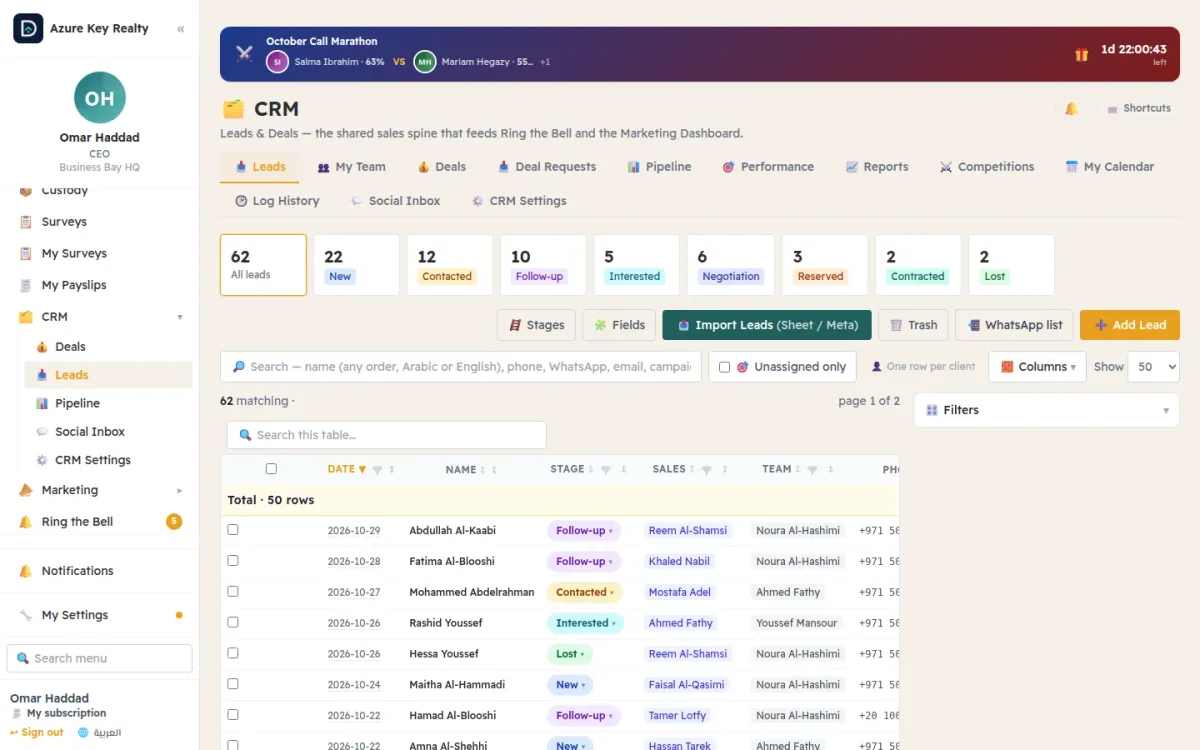
Once leads carry a persona, read the pipeline by persona. See which persona moves to a viewing fastest, which one stalls at the comparison stage, and which lead sources bring each one. Those answers refine the cards after every batch of closed deals.
Change follow-up and project matching for each persona
Tagging pays off in two places: what you send, and which projects you put in front of the buyer.
| Persona | Follow-up changes | Project matching changes |
|---|---|---|
| First-home family | Short messages that open with the monthly installment and delivery date | Projects in the preferred areas with the right phase and handover date |
| Investor | Payment plan and comparison first; reminders tied to launch deadlines | Two or three projects from different developers, laid side by side |
| Upgrader | A check-in about the sale of the current home before any pitch | Projects whose delivery fits the sale timeline |
| Overseas buyer | Video calls and files sent by chat; slower, clearer steps | Projects where files and payment steps can be shared remotely |
| Second-home buyer | Visual material first, numbers second; seasonal timing | Coast or resort projects with amenities in front |
For wording at each stage, real estate follow up messages gives message examples you can adapt to each persona's opening line.
For project matching, Dealora's Developers & Projects module keeps developers, their projects, phases and files. The Projects Map shows projects on a map and lets you send project files to a client. Both are on the Starter plan, so they are part of the free trial.
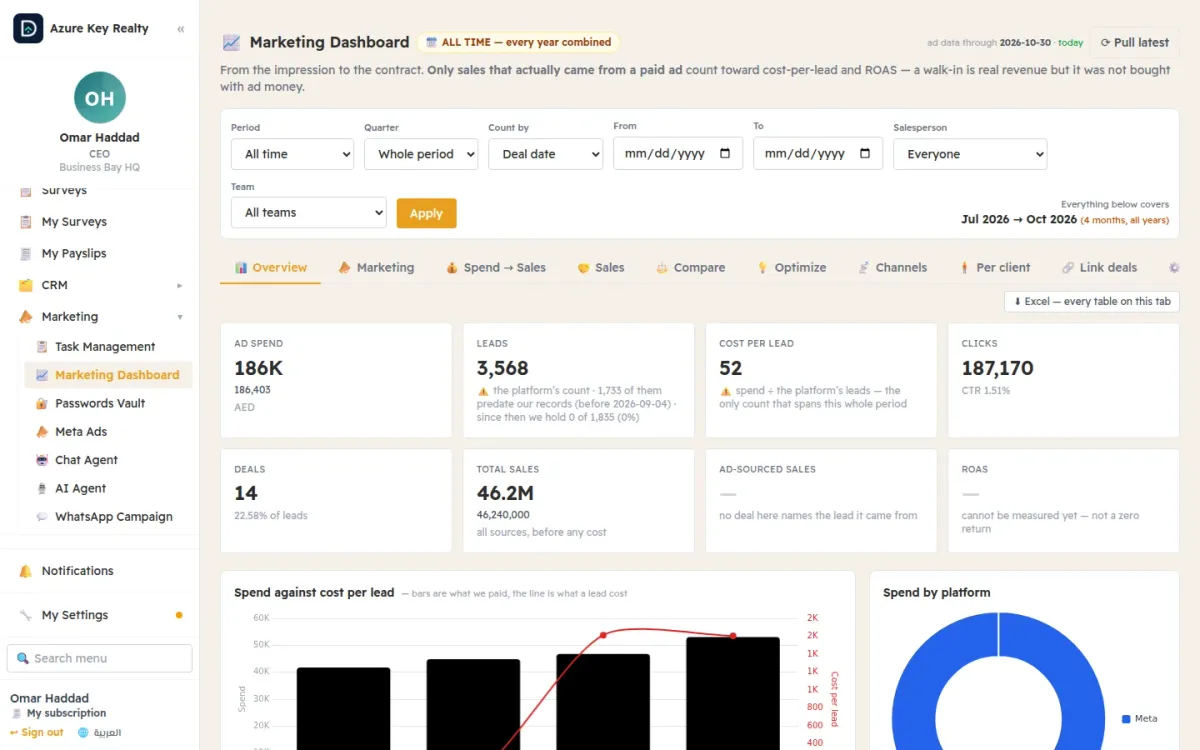
Two modules help once the team scales the cards. The Marketing Dashboard shows spend, leads, cost per lead and return on ad spend; it is on the Growth plan and above. Read it next to your persona tags to see which campaigns bring which buyers.
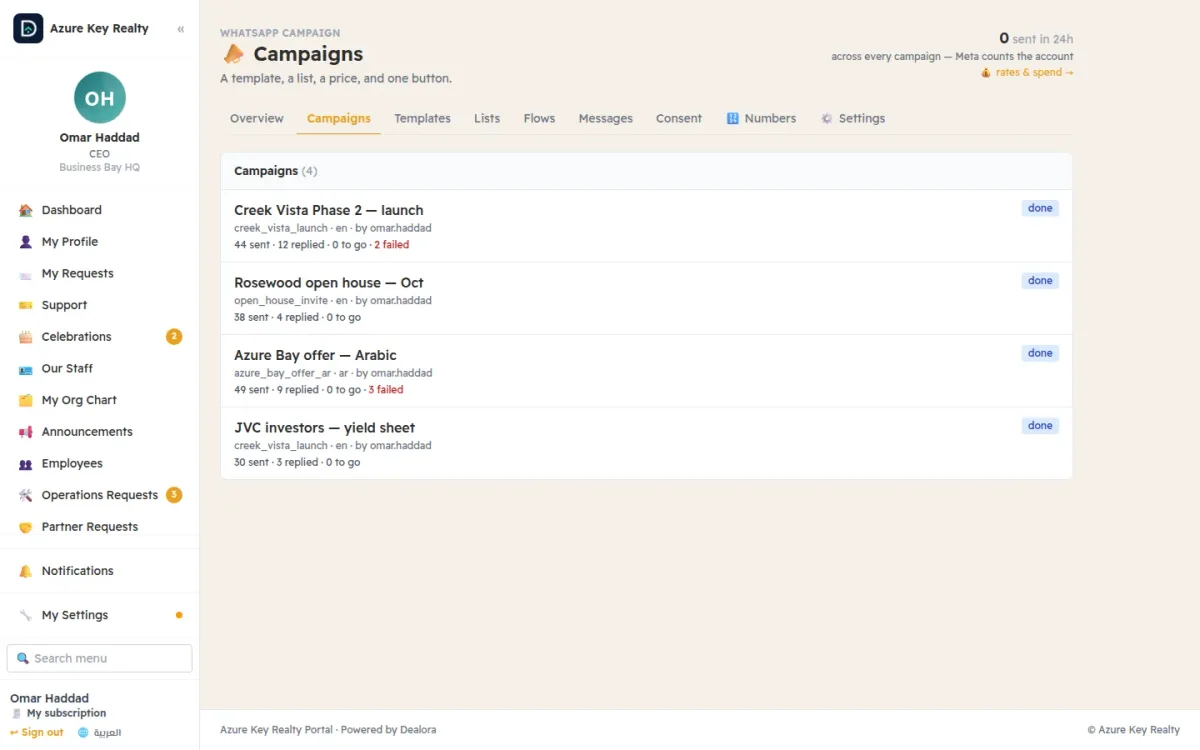
WhatsApp Campaign sends bulk messages with approved templates and is also on Growth and above. It works only with the company's own Meta connection: its Facebook page, Instagram and WhatsApp Business number. Write one template per persona, and send it only to buyers who agreed to receive marketing messages.
To build the client list the personas sit on, see how to build a real estate client database in your CRM.
Keep the card lean: consent and sensitive data
A persona describes a pattern, but the tag sits on a real person's record, and that record feeds marketing messages. In Saudi Arabia, the Implementing Regulation of the Personal Data Protection Law defines direct marketing in its Article 1 as communicating with a person by any direct physical or electronic means in order to send marketing material, including advertisements and promotions.
Under Article 29, a company sending direct marketing must state its identity clearly, without anonymisation, and must meet the Article 29 conditions before processing personal data for marketing. Consent must be explicit, meaning direct consent given in a form that clearly shows acceptance and whose obtaining can be proven. It must also be given freely, not obtained through misleading methods. A person may withdraw consent at any time.
Sensitive personal data may not be processed for marketing purposes in Saudi Arabia, even with the person's consent. So keep sensitive attributes out of persona tags and fields altogether. The authority that oversees and enforces the law, SDAIA, announced 48 violation-committee decisions in January 2026, and marketing-consent violations are among the breaches its committees have penalised.
In practice: record the date and channel of each consent, honor withdrawals the same day, and make sure persona tags describe buying needs, not personal characteristics. Brokerages in the United Arab Emirates and Egypt should check the data protection rules of their own market before sending persona-based campaigns.
Roll the cards out this week
Start small. Take the last batch of closed deals, fill the four fields for each, and draft three to five cards. Add the tag and the four fields to the CRM, tag your open leads, and ask each salesperson to correct the tags they disagree with. After the next batch of closed deals, merge, split or rewrite the cards.
To try it on real data, start the free trial with a free Dealora account: 3 months on the Starter plan, with Employees, CRM, Developers & Projects, Projects Map and Developer Sales index (no data export). For the modules beyond Starter, such as the Marketing Dashboard or WhatsApp Campaign, talk to the Dealora team about the right plan, user limits and add-ons through the Dealora plans page.
Sources
Frequently asked
What fields go in a real estate buyer persona template?
Four fields carry the card: budget (the range and how the buyer pays), location (preferred areas and the one that is not negotiable), purpose (live in, rent out, resell or second home) and timeline (when the buyer must decide). Add a short persona name and a one-line follow-up rule so the card is usable by every salesperson.
How do you create a buyer persona for real estate without survey data?
Start from your closed deals. For each one, write down the budget, location, purpose and timeline, then group deals that look alike. Name each group, merge groups that only have one or two deals, and test the cards on open leads. Your own contracts and call notes are better evidence than outside averages.
How many buyer personas should a brokerage have?
Use as many as your closed deals show as repeating groups. Five is a workable first set for most sales teams. If a persona matches only one or two deals, merge it into a neighbor. Too many cards means salespeople stop choosing between them and the tags lose their value in reports.
How do you store a buyer persona in a CRM?
Give each persona a short code and attach one primary persona to every lead as a tag or a single-choice field. Add the four card fields as fixed choice lists, plus a target decision date. Fixed lists let you group the pipeline and reports by persona instead of reading free-text notes.
Does a buyer persona replace lead qualification questions?
No. Qualification questions collect the facts for one lead; the persona is the pattern those facts fall into. Ask the questions first, then choose the closest persona, and mark it as confirmed by the buyer or guessed by the salesperson so you can correct it later.
Can I try persona tagging in Dealora for free?
A new company gets 3 months free on the Starter plan, which includes the CRM, Employees, Developers & Projects, Projects Map and Developer Sales index (no data export). Create a free account and check how the four fields and a persona label fit in the lead record.
Related

Read next
- Real Estate Drip Campaign: Build a Follow-Up Sequence A step-by-step build of a real estate drip campaign for new property leads: the trigger, five messages over 14
- All in One vs Separate Real Estate Software: How to Decide Five apps for CRM, WhatsApp, ad reports, HR and files cost a brokerage hours of re-typing and lost lead histor
- Lead to Deal Conversion Rate: How to Calculate It by Stage A step-by-step method to calculate your lead to deal conversion rate: fix the counting rules, follow one cohor
- How to Set Up a Brokerage on Dealora: A Week-by-Week Checklist A two-week order for your first Dealora account: people and permissions, pipeline and sources, clients and lea