
Hot Warm Cold Leads Real Estate: How to Classify and Follow Up
By Keys of Success Written Published Reviewed by Ali Darwish 10 min read
A written scoring rule for hot, warm and cold leads: four signals, a point total per group, a follow-up rhythm, rules for moving leads and a CRM field that keeps it visible.

To classify hot, warm and cold leads in real estate, score each lead from 0 to 3 on budget, timeline, behavior and response, then add the points. Treat 9-12 as hot, 5-8 as warm and 0-4 as cold. Store the result as a CRM field so every salesperson sees the same temperature on the pipeline.
Hot, warm and cold leads in real estate are three groups that tell a salesperson how soon a prospect is likely to buy and how much attention the lead deserves today. A hot lead has a budget, a near date and is actively engaging. A warm lead is interested but not ready. A cold lead has shown little intent or has gone quiet. The grouping only works when every salesperson scores by the same written rule and the result sits in the CRM, not in someone's memory.
Hot, warm and cold leads real estate teams handle: what each group means
Temperature describes readiness to buy, not the quality of the person or how pleasant the conversation was. Two leads from the same ad can sit in different groups the next morning. That is why the label has to be re-checked, not stamped once.
- Hot: a clear budget, a buying date close enough to act on, and recent actions that show intent, such as asking for a price list, a payment plan or a viewing.
- Warm: real interest in a project or area, but one thing is missing: a date, a confirmed budget or a decision-maker in the conversation.
- Cold: a vague enquiry, no date, no budget, or no reply after several attempts.
Temperature is also different from the type of client. An investor and an end user can both be hot. If you need to separate buyer segments first, our article on types of clients in real estate shows six groups and how to tag them. Segment answers "who is this buyer", temperature answers "how soon will they act".
Keep in mind that first-time buyers were a record-low 21% of U.S. buyers in the NAR 2025 Profile, with a median age of 40. Many of your leads will be repeat buyers, and their timelines differ: someone selling one property to buy another may be firm on budget and loose on date. The scoring below handles that by looking at four separate signals.
Why one written rule beats each salesperson's judgment
When each person decides what "hot" means, the pipeline becomes unreliable. One salesperson calls a lead hot because the client was friendly. Another calls the same lead cold because no date was given. Managers then cannot say how many hot leads the team holds or who should call first.
Speed makes the difference concrete. A 2011 Harvard Business Review article by James Oldroyd, Kristina McElheran and David Elkington reported two findings. In an audit of 2,241 US companies, those that answered a web lead took 42 hours on average. In a separate analysis of 1.25 million leads at 42 US companies, firms that tried to contact a lead within an hour were nearly seven times as likely to qualify it as firms that waited even one hour longer.
Buyers still lean on agents: 88% of U.S. buyers in the NAR 2025 Profile bought through a real estate agent or broker, so the agent who responds and qualifies a lead first is well placed to win it.
These are U.S. and general sales figures, and Egyptian and Gulf markets have their own habits. The direction is still useful: a shared rule decides which leads get the first call in minutes, and which can wait for tomorrow. For the wider path from enquiry to contract, see this walkthrough of real estate leads from lead generation to closed deal.
The four signals for lead scoring in real estate
Score every lead on four signals, each from 0 to 3 points. Four signals keep the rule short enough that a salesperson can apply it in a minute, and wide enough that one strong signal cannot hide three weak ones.
Budget
Budget tells you whether the lead can afford what you sell. Give 3 points when the lead states a figure or range that matches your available inventory and the payment method is clear. Give 2 for a range that roughly fits, 1 for a vague answer, and 0 when the lead refuses to discuss money or the budget is far from anything you have. Ask the budget question in the first call, in a friendly way, because it is the quickest filter.
Timeline
Timeline is the date by which the lead wants to buy or reserve. A starting set of cut-offs: 3 points for within 30 days, 2 for 31-90 days, 1 for 91-180 days, and 0 for no date or "just looking".
Set the bands from your own history rather than a generic number. U.S. home buyers searched for a median of 10 weeks in the NAR 2025 Profile of Home Buyers and Sellers (transactions from July 2024 to June 2025), the same as the year before, but the figure varies by year and by market. Look at your closed deals and measure the weeks between first enquiry and signing. Then move the cut-offs to fit.
Behavior
Behavior is what the lead does, which is more reliable than what the lead says. Actions such as asking about a unit in a chat or replying to a campaign carry real meaning, because they cost the lead some effort.
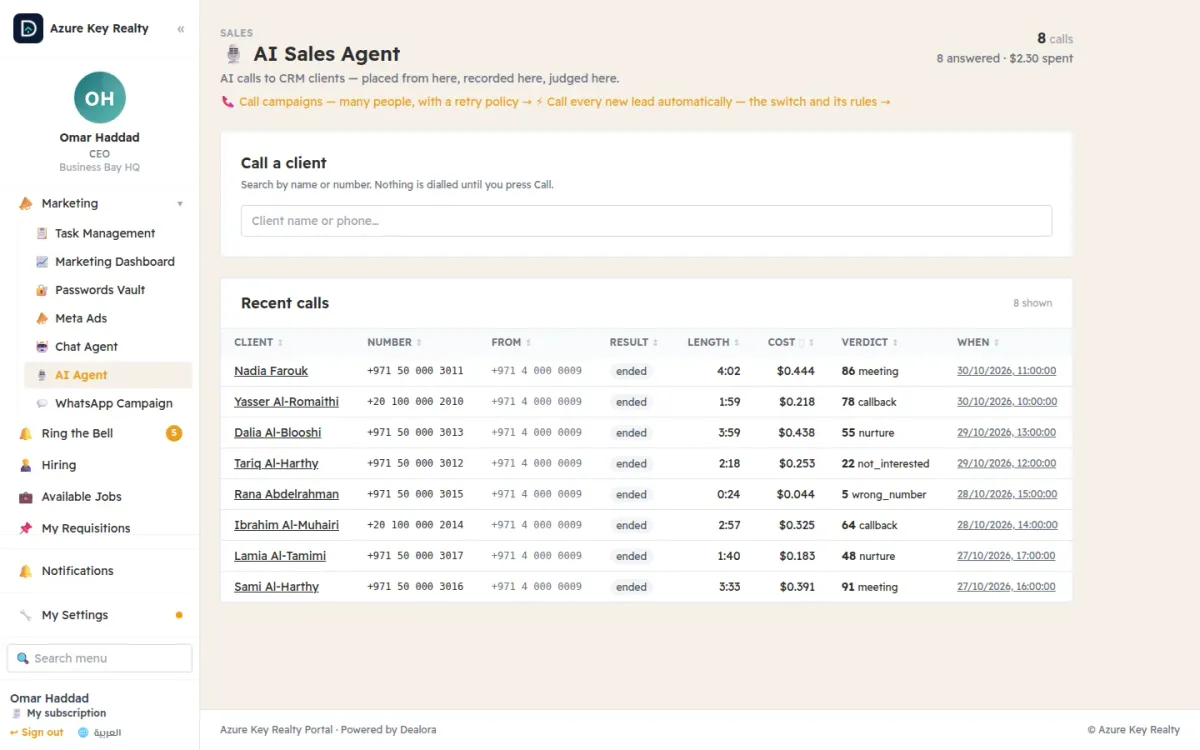
Give 3 points for asking for a viewing, a price list, a payment plan or a reservation. Give 2 for asking about a specific project or unit, or replying to a campaign with a question. Give 1 for a like, a click or a one-word reply. Give 0 for no action since the enquiry. When Facebook, Instagram and WhatsApp conversations arrive in one place, as they do in the Social Inbox inside the CRM, the salesperson can see these actions without switching apps.
Response
Response measures how the lead reacts to your contact. Give 3 points for replying or picking up within a day, 2 for replying within a few days, 1 for replying occasionally, and 0 for no reply after three attempts. If your team uses AI phone calls for first contact, the recording and the verdict on each call give the salesperson something concrete to base this score on.
The point rule in one table
| Signal | 3 points | 2 points | 1 point | 0 points |
|---|---|---|---|---|
| Budget | Stated, fits inventory, payment method clear | Range that roughly fits | Vague | Refused or far off |
| Timeline | Within 30 days | 31-90 days | 91-180 days | No date |
| Behavior | Asked for viewing, price list or payment plan | Asked about a specific unit | Like, click or one-word reply | No action |
| Response | Replies within a day | Replies within days | Occasional reply | No reply after 3 attempts |
Add the four scores. A total of 9-12 is hot, 5-8 is warm and 0-4 is cold. Add one override: any lead who asks for a viewing or a reservation is hot, whatever the total.
Here is a worked example. A lead arrives from an Instagram ad and asks about a two-bedroom unit in a named project (behavior 2). She says she wants to buy within two months (timeline 2), gives a budget range that fits (budget 2), and replied within the hour (response 3). The total is 9, so she is hot and gets a call straight away.
Follow-up rhythm for each group
A temperature without an action is only a label. Attach a rhythm to each group, and treat the figures below as a starting point to adjust after a few weeks of results.
- Hot: first contact within 5 minutes of the enquiry, then daily contact until a viewing or meeting is booked. If the lead does not answer, try a different channel the same day.
- Warm: contact every 3-4 days for the first two weeks, then weekly. Each touch must bring something new, such as a shortlist, a brochure for a matching project or a payment plan comparison.
- Cold: contact monthly, or include the lead in campaigns and broadcast messages. Stop individual calling until the lead shows a new signal.
Warm leads follow up best when the message helps the buyer decide. In the NAR 2025 Profile, 50% of buyers said what they mainly wanted from an agent was help finding the right home to purchase. A shortlist with honest notes does more than "just checking in".
Source also shapes the first call. A referred lead deserves a personal call from the person who was recommended, and the CRM should show the referrer.
Rules for moving a lead between groups
Scores change as leads act. Without movement rules, hot lists fill with stale names and cold lists hide buyers who woke up last week.
- Move up at once. Re-score the same day when a lead replies after silence, asks for a viewing or gives a date. A cold lead that returns is re-scored, not left in the monthly list.
- Move down on a clock. If a hot lead has no reply for 7 days, drop it to warm. A warm lead with no reply for 30 days drops to cold. Choose your own limits, but write them down.
- Re-score weekly. Once a week, the salesperson reviews every hot and warm lead and updates the four signals.
- Record the reason. Every change needs a one-line note, such as "asked for viewing" or "no reply since the 3rd". The notes become the training material for new staff.
- Cap the hot list. If one salesperson has more hot leads than they can call in a day, the manager reassigns some. Distribution rules help here, and this piece on real estate sales pipeline stages, exit rules and time limits shows how time limits work per stage.
How to set lead temperature in your CRM
The rule only helps when the temperature is visible to everyone. In a spreadsheet or a chat group it disappears within a week. In a CRM it can sit next to the stage and the source of every lead. A CRM such as our CRM for leads, clients, deals and the pipeline in Dealora, the real estate ERP Keys of Success built and runs, is the right place for it, since leads, the pipeline, sources and reports are already together.
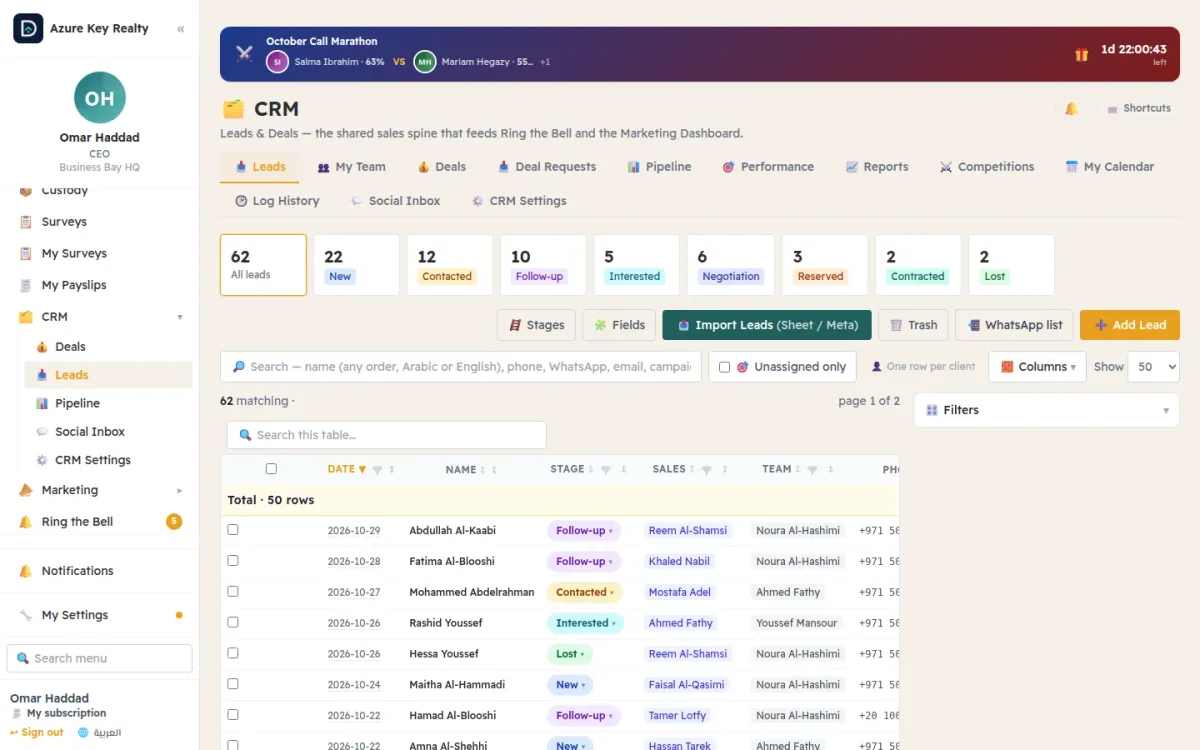
- Create the field. Add a single-choice field called Temperature with three values: Hot, Warm, Cold. Add a number field called Score, from 0 to 12.
- Make it required. A lead cannot leave the first stage without a temperature, and a stage change prompts a re-check.
- Show it on the pipeline. Display the temperature on each lead card and as a column and filter in the lead list, so a salesperson can start the day with the hot leads.
- Add the supporting fields. Last contact date, next follow-up date and the reason for the last change. Overdue follow-ups on hot leads should stand out.
- Report on it. Count leads per temperature for each salesperson and each source, then check conversion from each group.
Before you commit to a system, check that it supports a custom field that shows on the pipeline and in reports. Our real estate CRM comparison with 8 checks before you buy covers that along with other questions. If your current tool cannot do it, a connected system built around your workflow is an option, and that is what our custom software development service does. To see how a ready brokerage system handles leads, look at Dealora's real estate CRM software.
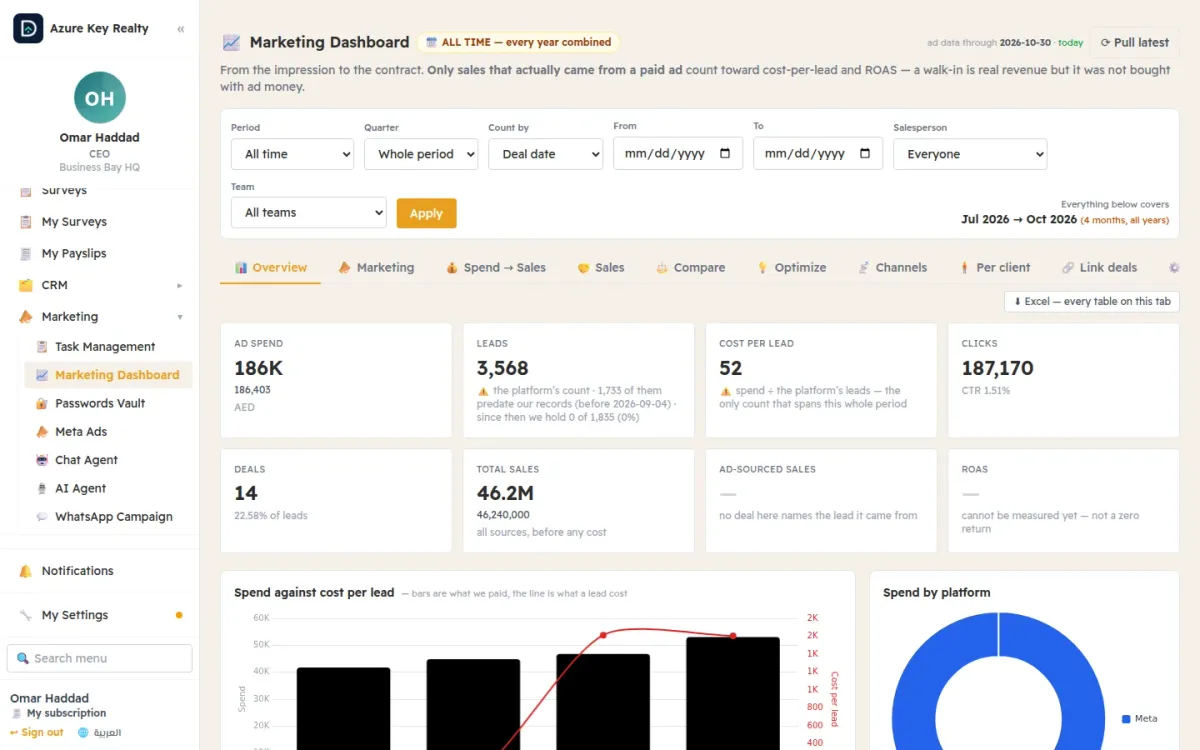
The reports are where the rule proves itself. If hot leads convert far better than warm ones, the scoring works. If the gap is small, move the cut-offs or the weights. The marketing dashboard from spend to leads to sales adds the source view: it shows cost per lead and return on ad spend, so you can see which campaigns bring hot leads and which fill the cold list.
Mistakes that break lead temperature
- Scoring once. A label set on day one and never revisited turns the field into decoration. The weekly re-score fixes this.
- Adding tiers. "Very hot", "lukewarm" and "ice cold" confuse the team. Three groups plus the point total are enough.
- Letting enthusiasm decide. A cheerful lead with no budget and no date is warm at best. Follow the points.
- Ignoring cold leads. Cold does not mean dead. A monthly message keeps the brokerage in mind for when the lead's situation changes.
- Keeping the rule unwritten. If new staff learn it by listening to others, every office ends up with its own version. Put the table on one page and share it.
A first step you can take this week
Take your last 50 leads, including the ones that closed and the ones that vanished. Score each one with the four signals as they stood after the first week. Then compare the temperature with what happened. Where the rule predicted badly, change one cut-off, and then create the Temperature field in your CRM so the next batch is scored from day one.
Sources
Frequently asked
What is the difference between hot, warm and cold leads in real estate?
A hot lead has a stated budget, a near buying date and is actively engaging, for example asking for a viewing. A warm lead is interested but missing a date, a budget or a decision. A cold lead has shown little intent or stopped replying. The difference is readiness to buy now, not how friendly the person sounds.
How do you score real estate leads?
Give each lead 0 to 3 points on four signals: budget, timeline, behavior and response. Add them up. A total of 9-12 is hot, 5-8 is warm and 0-4 is cold. Add one override: a lead who asks for a viewing or reservation is hot whatever the total.
How fast should you contact a hot lead?
Set a team target measured in minutes, such as within 5 minutes of the enquiry. A 2011 Harvard Business Review analysis of 1.25 million leads at 42 US companies found that firms that tried to contact a lead within an hour were nearly seven times as likely to qualify it as firms that waited even one hour longer. After the first call, contact daily until a viewing is booked.
How often should you follow up with warm and cold leads?
A workable starting point is every 3-4 days for warm leads during the first two weeks, then weekly, with something new in each message such as a shortlist or a brochure. Cold leads can be contacted monthly or through campaigns. Adjust the rhythm after checking which groups actually convert.
Should lead temperature be a field in the CRM?
Yes. A required single-choice field (hot, warm, cold) on the lead record keeps the classification visible on the pipeline and usable in reports. When temperature lives in each salesperson's head, managers cannot compare conversion by group, review who needs a call today or spot leads that went stale.
Related

Read next
- Real Estate Drip Campaign: Build a Follow-Up Sequence A step-by-step build of a real estate drip campaign for new property leads: the trigger, five messages over 14
- How to Get Real Estate Referrals: A Post-Closing Routine Referrals come from a routine, not a favor. Tag every closed deal, schedule follow-ups after handover, ask at
- All in One vs Separate Real Estate Software: How to Decide Five apps for CRM, WhatsApp, ad reports, HR and files cost a brokerage hours of re-typing and lost lead histor
- Lead to Deal Conversion Rate: How to Calculate It by Stage A step-by-step method to calculate your lead to deal conversion rate: fix the counting rules, follow one cohor