
Property Buying Cycle Stages: A Broker's Map With CRM Statuses
By Keys of Success Published Updated Reviewed by Ali Darwish 11 min read
A stage-by-stage map of how property buyers decide, with the signals that place a client in each stage, a follow-up rhythm and the CRM status that makes the next action obvious.

The property buying cycle runs through seven stages: trigger, research, enquiry, viewing, negotiation, commitment and registration. Each stage has its own client signals and follow-up pace. Tag the stage as a status in your CRM so every client has one clear next action. Off-plan, resale and investor buyers need different handling.
The property buying cycle has seven stages: trigger, research, enquiry, viewing, negotiation, commitment and registration. A buyer rarely moves through them in a straight line, but each stage has behavior you can recognize and a follow-up that suits it. For a broker in Egypt or the Gulf, the useful move is to write the stage down as a status in the CRM, so that every client has one obvious next action and nobody is chased with the wrong message.
How long does it take to buy a property?
There is no single figure for Egypt, Saudi Arabia or the UAE, and we will not invent one. A reference point from the US market shows how slowly the decision moves: in the National Association of Realtors' 2025 Profile of Home Buyers and Sellers, buyers searched for a median of 10 weeks. The number shifts with the market, the price of the property and the buyer's urgency, so treat it as a sense of scale, not a benchmark.
The same US report shows how much buyers still lean on brokers: 88% bought through an agent or broker, and NAR describes agents as buyers' most trusted and most frequently used source of information, ahead of online listings. Many buyers research on their own before calling anyone, and the broker is valued later, which is why the early stages matter: staying helpful and visible during research puts you in a better position at the viewing stage.
Your own CRM is the better benchmark. Once every client carries a stage status with a date, you can see how many days your typical buyer stays in each stage and where deals stall.
The seven property buying cycle stages, one by one
The timings below are a suggested working rhythm, not statistics. Adjust them against your own closed deals after a few months of recorded data.
Stage 1: Trigger
Something changes: a marriage, a growing family, a bonus, a lease ending, spare capital that should work harder. The client is not yet looking at specific properties and often does not describe themselves as a buyer. Signals are vague questions, a follow on a social page, a comment on an ad, a request for general information on an area.
Keep contact light. A useful reply and a record of the source are enough. Check back after a few weeks with something relevant, such as a new phase or a price change in the area they asked about.
Stage 2: Research
The client compares areas, developers, prices and payment terms, mostly alone and mostly online. Signals are requests for brochures and price lists, many questions about the developer, and comparing two or three projects in one message. They are not ready for a hard sales call.
Send material that answers the question they asked and nothing else. A brochure library kept in one place makes this fast, and a map of projects helps when the question is about location.
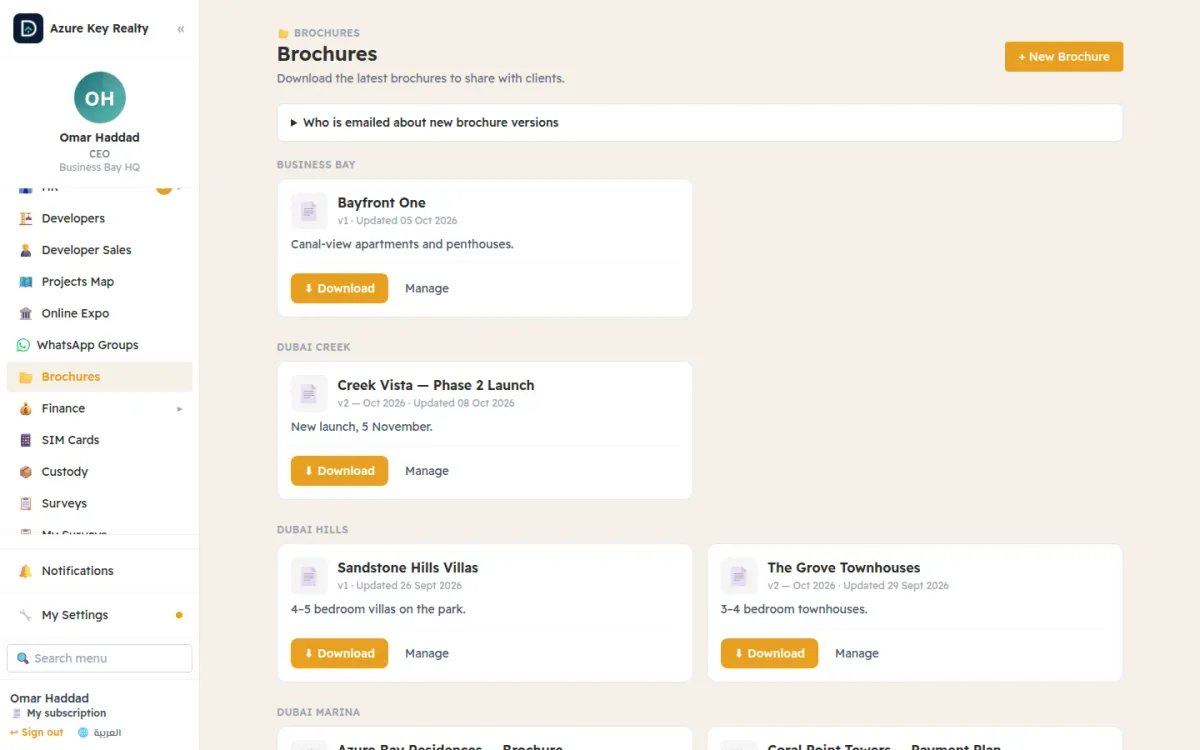
A gentle rhythm works here: a reply the same day, then a check-in every two to three weeks that adds something new. Daily messages push this client away.
Stage 3: Enquiry
The client now talks to a broker with a shortlist and a rough budget. Signals are specific unit questions, a stated budget, a timeline, a request to speak by phone. This is where qualification happens, and the questions are covered in our list of real estate lead qualification questions to ask before a viewing.
Speed matters most at this stage. Reply within the same working day, preferably within the hour for a new enquiry, and book the next step before the call ends. Record budget, purpose, timeline and who else takes part in the decision.
Stage 4: Viewing
The client wants to see the unit, the show apartment or the sales center, in person or on video. Signals are a requested time slot, a spouse or relative joining, questions about parking, finishing, service charges or the neighborhood. Viewings are also where people decide that something is wrong, so prepare the client before the visit and ask for honest reactions afterwards.
Follow up the same day or the next morning, while the impression is fresh. Ask which unit they liked and what held them back, and write the answer in the CRM note. If they viewed three units, record the ranking.
Stage 5: Negotiation
The client asks about discounts, payment schedules, the down payment, furniture, handover date or a better unit. Signals are repeated contact, numbers exchanged back and forth, a request for the contract draft, or a mention that they are talking to another broker. They are close, and also at their most anxious.
Stay in daily contact while an offer is open, and answer every number the same day. Agree who can approve what on your side so the client never waits for an answer that nobody owns.
Stage 6: Commitment
The client pays a reservation or booking amount, or signs the contract. Signals are payment confirmations, ID copies, a request for the payment schedule in writing. The next risk is doubt after the decision, so confirm every step in writing and tell the client what happens next and when.
Stage 7: Registration and handover
The deal is signed, but the buyer's experience is not finished. The client is waiting for registration, installments, handover or keys. Contact them at each milestone, even when there is no news. This stage produces the referrals and reviews that feed Stage 1 for other buyers.
Signals that place a client in a stage
Clients rarely announce their stage. Read the request, not the greeting.
| Stage | Typical signal | Next action | Suggested rhythm |
|---|---|---|---|
| Trigger | General question, ad comment | Useful reply, log the source | Check in every few weeks |
| Research | Brochure and price list requests | Send matching material | Reply same day, then every 2-3 weeks |
| Enquiry | Budget and timeline given | Qualify, book a viewing | Same day, within the hour if possible |
| Viewing | Time slot requested | Prepare, then debrief | Same day or next morning |
| Negotiation | Discount and schedule questions | Answer offers, agree approvals | Daily while an offer is open |
| Commitment | Payment or documents sent | Confirm in writing | At every step |
| Registration | Waiting for paperwork | Milestone updates | At each milestone |
How to tag each stage as a status in a CRM
A stage status only helps if it is simple and honest. Use plain names that a salesperson can pick in two seconds: Exploring, Researching, Enquiring, Viewing, Negotiating, Committed, Registering. Every client record needs the stage, the date it was set, the source and one next action with a due date.
Two rules keep the data clean. First, move a client forward only when you see the signal from the table, never on a hunch. Second, set a time limit per stage and review anyone who has stayed past it. A client in Research for three months is not necessarily lost, but somebody should decide that deliberately.
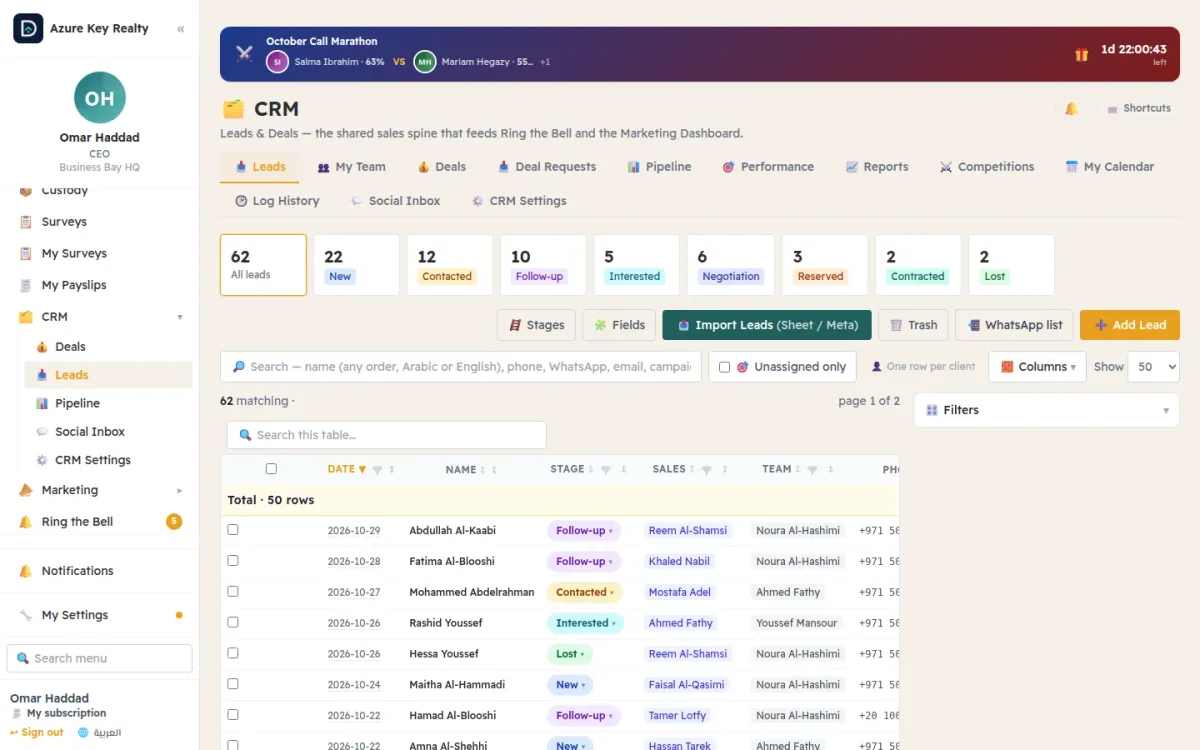
In the CRM feature of Dealora, leads, clients, deals, the pipeline and sources sit in one place, which is the structure this tagging needs. Whichever tool you use, check it against the points in our real estate CRM comparison before you commit. For a worked setup of the pipeline itself, the Dealora team describes the real estate sales pipeline with exit rules and time limits.
Stage is not the same as client type
Stage describes where the client is in the decision. Type describes who the client is: end user, investor, returning buyer and so on. Keep them as two separate fields so you can segment real estate clients by stage and by type, for example "investors in Negotiating". Our article on types of clients in real estate shows six buyer segments and how to tag them.
Keep the conversation in one record
Much of a brokerage's client conversation happens on WhatsApp, so the stage signal often arrives in a chat, not a call. When messages from social channels land in the same record as the client, the salesperson sees the signal and updates the status. The Social Inbox brings Facebook, Instagram and WhatsApp messages inside the CRM for that purpose.
How the cycle changes for off-plan, resale and investor buyers
The seven stages stay the same. What changes is the weight each stage carries and what you do while the client waits.
Off-plan buyers
Research is longer and centered on the developer: track record, phases, payment plan, handover. Viewing may be a sales center, a model unit or a video call, not the finished property. Commitment carries formal steps that differ by country, and the broker should know them well enough to explain.
- Dubai: a typical purchase runs from choosing a project, to confirming DLD registration, to a booking deposit into the escrow account, then the Sale and Purchase Agreement, then registration on the interim register (Oqood), and payments by plan until handover. The developer, not the buyer, files the Oqood registration request, and the output is emailed to the buyer. Each off-plan project must have its own escrow account at a DLD-accredited bank, and off-plan sales made before project approval and registration are void. The 4% registration fee applies to off-plan and completed property alike, and contracts often shift all of it to the buyer.
- Saudi Arabia: reservation amounts and buyer payments must go into the project's designated escrow account, held in Saudi riyals. In Wafi projects, a developer can take reservations during the marketing licence period only if it discloses the project's current status and future plans, and escrow withdrawals follow verified construction progress.
- Egypt: a preliminary contract binds buyer and seller but does not grant official ownership until the sale is registered with the Real Estate Publicity Department under the Ministry of Justice. Rules and costs vary, so confirm each case.
Follow-up rhythm for off-plan: slower during research, steady at commitment, and regular milestone updates for the long wait after. The Dealora team walks through the off-plan sales process for brokers step by step.
Resale buyers
Resale buyers spend less time on research and more on viewings and negotiation, because the unit exists and its price can be tested. Expect more viewings, more questions about the condition of the unit and the seller's flexibility, and a negotiation that includes both sides. Tighten the rhythm after a viewing, and keep the seller informed too.
The legal stage sits closer to the end. In Egypt, registration usually needs the validated preliminary contract, both parties' IDs, the previous title deed, proof of payment, tax clearance, utility clearance and a cadastral survey or site plan, though requirements vary. Since the 2020 amendment of the Real Estate Registration Law, the registration fee for a unit is a fixed amount set by its area, from EGP 500 for up to 100 m² to EGP 2,000 for more than 300 m², rather than a percentage of the price. Other charges are added on top, so confirm the current total with the Real Estate Publicity office before quoting it to a buyer. Give the buyer a checklist early so the Commitment stage does not stall on paperwork.
Investor buyers
Record investor as a buyer type in its own field, separate from the stage, so every investor in your pipeline can be found and followed up with specifics instead of a generic message. Write each question an investor raises against the client record, so the next reply answers it directly. Our article on property investor vs end user buyer shows how to tell the two apart and pitch each.
Updating investors in bulk with WhatsApp Campaign
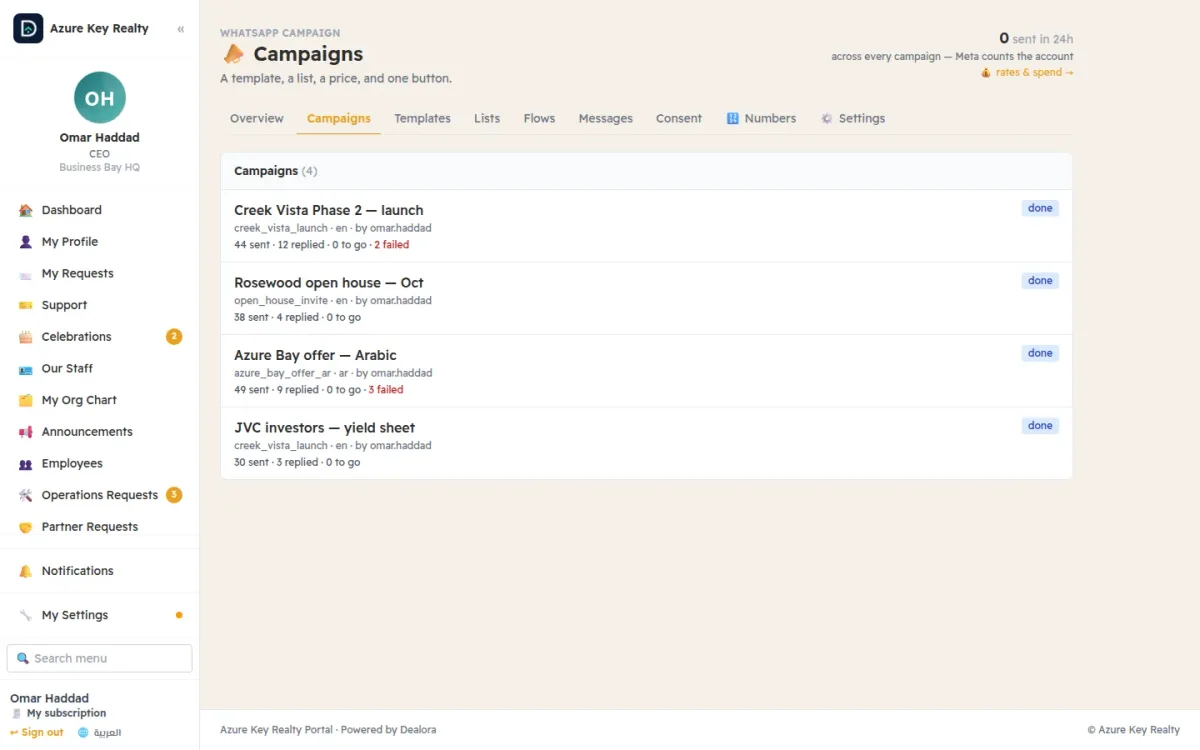
For investors, send concise updates tied to a specific opportunity, such as a new release or a changed payment plan. A bulk message works for a launch only if the content is relevant to that client. The WhatsApp Campaign feature sends bulk campaigns with approved templates, and the reply counts show which clients responded, so they can be moved to the right stage.
Common mistakes when mapping the buyer journey
- Chasing everyone at the same speed. A client in Research and a client in Negotiation need different contact, and one rhythm fails both.
- Moving a stage because the client was polite. Friendliness is not a signal. A request for a price, a slot or a contract is.
- Leaving stale statuses. If nobody reviews clients past their time limit, the pipeline fills with names that mean nothing.
- Forgetting after the sale. Stage 7 is where trust is built, and it affects the next buyer who hears about you.
- Using one cycle for every buyer. Off-plan, resale and investor deals differ in what the buyer needs next.
A practical next step
Take your last ten closed deals and mark when each client reached each of the seven stages, using call logs and chats. Look for the stage where clients waited longest, then write a time limit and a next action for it. If you want the structure ready to use, the team at Keys of Success built real estate CRM software for brokerages for exactly this daily follow-up, and you can reach us through the contact page if you want help adapting it to your sales process.
Sources
Frequently asked
What are the stages of the property buying cycle?
A practical map for brokers has seven stages: trigger, research, enquiry, viewing, negotiation, commitment and registration. Each one has recognizable client behavior, such as saving listings, asking about payment terms or requesting the contract. Naming the stage in your CRM tells the salesperson what to do next.
How long does it take to buy a property?
It varies by market, property type and buyer. As a reference point, US buyers searched for a median of 10 weeks in 2025, according to the National Association of Realtors. Markets in Egypt and the Gulf have their own pace, so measure your own deals instead of relying on a general figure.
How do I know which stage a client is in?
Look at what the client does, not what they say. Asking for the price list suggests research, asking for a viewing slot suggests viewing, and asking about discounts or payment schedules suggests negotiation. Confirm the signal with one qualifying question and record the stage in your CRM.
Do off-plan and resale buyers follow the same stages?
The stages are the same but the weight differs. Off-plan buyers spend longer on research and developer trust, and the commitment stage involves booking deposits and registration steps. Resale buyers spend more time on viewings and negotiation, and the legal and document checks fall on the seller and buyer.
How should a CRM track buyer stages?
Give each client one stage status, a date it was set and a next action with a due date. Add a source and a buyer type such as end user or investor. Review clients whose stage has not changed within the time limit you set for that stage.
Related

Read next
- Real Estate Drip Campaign: Build a Follow-Up Sequence A step-by-step build of a real estate drip campaign for new property leads: the trigger, five messages over 14
- Real Estate Retargeting Tools: Which Channel Fits Each Lead Stage Cold lead, silent viewer, post-offer buyer or past client: each needs a different channel. A stage-by-stage co
- Reactivate Old Property Leads: A 4-Step WhatsApp Plan A practical four-step plan for brokers: segment the stale lead list, write one short personal message, send it
- All in One vs Separate Real Estate Software: How to Decide Five apps for CRM, WhatsApp, ad reports, HR and files cost a brokerage hours of re-typing and lost lead histor