
Software for Riyadh Property Agencies: 9 Tests Before You Buy
By Keys of Success Published Reviewed by Ali Darwish 10 min read
A buying checklist for a Riyadh brokerage office: nine tests for Arabic and English screens, client records, WhatsApp, developer data, REGA paperwork, HR tools and the free trial.

Good software for Riyadh property agencies is a bilingual Arabic and English portal that keeps client records, WhatsApp and social messages, developer and project data and team tools together. Test it with nine checks: right-to-left screens, Arabic records, one inbox, developer data, REGA paperwork, HR, reports, users and export, and a 90-day trial.
The right software for Riyadh property agencies is a bilingual Arabic and English portal that keeps client records, WhatsApp and social messages, developer and project data and team tools in one place, and that you can try with real work before you pay. Nine tests below check exactly that, in the order they come up in daily work. Keys of Success built and runs Dealora, a real estate portal sold in Egypt, Saudi Arabia and the United Arab Emirates, so the examples use its modules. The tests work on any tool you shortlist.
Why a Riyadh office needs its own checklist
Riyadh is a high-volume market. The city recorded about 6,944 residential transactions in the first half of 2026, up 4.9% year on year, with demand concentrated in affordable and mid-market segments and family-sized homes the largest share. In September 2026 the Riyadh region recorded about 6,447 real estate sales transactions worth SAR 9.06 billion, which was 29% of the Kingdom's transactions that month.
For an office, the practical questions are who your buyers are and how they reach you: in Arabic, in English, on WhatsApp or on social media. A brokerage also works with several developers at once and has to keep its brokerage paperwork in order with the Real Estate General Authority (REGA). The tests below check each of these against your own data. For a wider Saudi view, the real estate software Saudi Arabia checklist covers the national picture. This article stays with a Riyadh office and its size.
Nine tests for software for Riyadh property agencies
Run every test with your own data and your own staff, not the vendor's sample records.
Test 1: Do the screens work right to left?
Open the portal in Arabic and use it for a full working day. Menus, tables and forms should mirror properly, not just translate. Type an English project name inside an Arabic note and check that the line does not scramble. Look at how phone numbers, prices and dates read.
Then check the other direction: a manager who prefers English should be able to work without hunting for labels. Dealora is an Arabic and English portal, but the point of the test is that you see it on your own screens, with your own mix of languages.
Test 2: Can it hold Arabic client records?
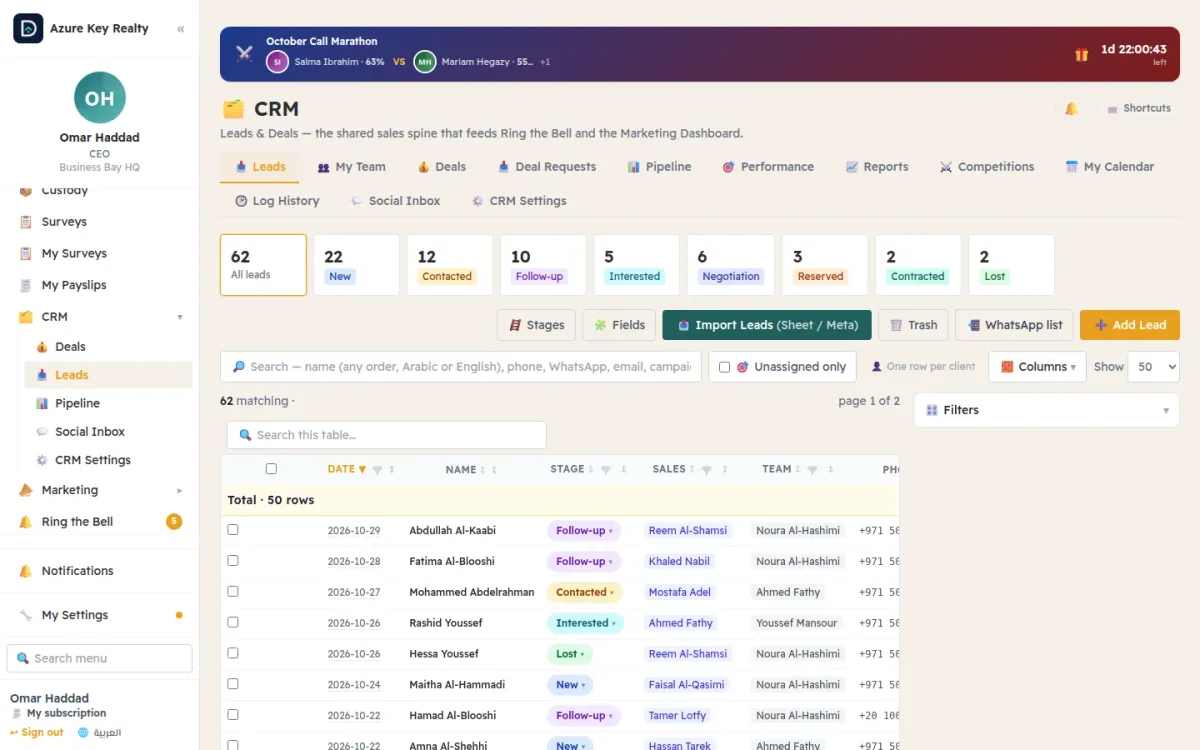
Enter ten real clients with Arabic names, an Arabic note and a phone number. Search for one client by name written two common ways. Add a duplicate phone number and see whether the system warns you. Then move a client through the pipeline and read the stage names in Arabic.
A CRM for a brokerage should hold leads, clients, deals, the pipeline, sources and reports. That is what the Dealora CRM covers, and it is on every plan. For the wider list of questions to ask any vendor, see the eight checks for comparing real estate CRMs.
Test 3: Are WhatsApp and social messages in one inbox?
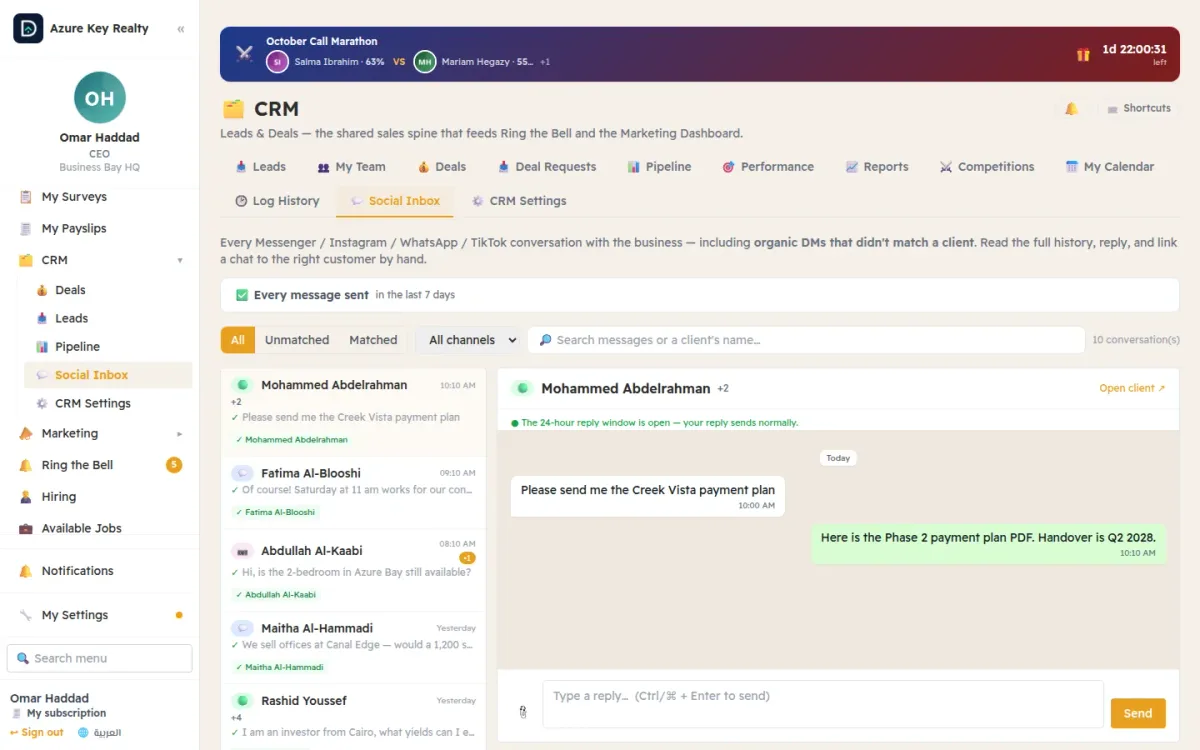
Start by checking where your own buyers write first: WhatsApp, Instagram, Facebook or the phone. If those chats stay on personal phones, the office loses the history when a salesperson leaves. The Social Inbox puts Facebook, Instagram and WhatsApp messages inside the CRM. It is on the Growth plan and needs your own Meta connection: your Facebook page, Instagram account and WhatsApp Business number. To test it, connect one WhatsApp Business number and one Instagram account, send a message from a second phone, and check that the conversation appears inside the CRM.
Also ask how the tool connects to WhatsApp and how that route is priced. Once a business is onboarded to the Cloud API, messages sent from the WhatsApp Business app stay free and sit outside the 24-hour window rules, while messages sent through the Cloud API follow Cloud API pricing. A tool should tell you which applies to each message.
Finally, check that it respects the rules of the channel. A 24-hour customer service window opens when a user messages or calls your business and resets with each new message or call. Inside it, free-form service messages are allowed. After it closes, only pre-approved template messages can be sent, and only to users who opted in. If you want after-hours replies, the Chat Agent answers customers on Instagram, Messenger, WhatsApp and TikTok from the company's own Knowledge. It is included from Growth, needs the AI Sales Agent add-on and the company's own Meta connection, and is charged by use as well.
Test 4: Does it hold developer and project data?
A Riyadh office sells for several developers, each with projects, phases, brochures and a sales contact. Test whether you can find a developer in two clicks, see its projects and phases, attach files, and send a project file to a client from the same screen.
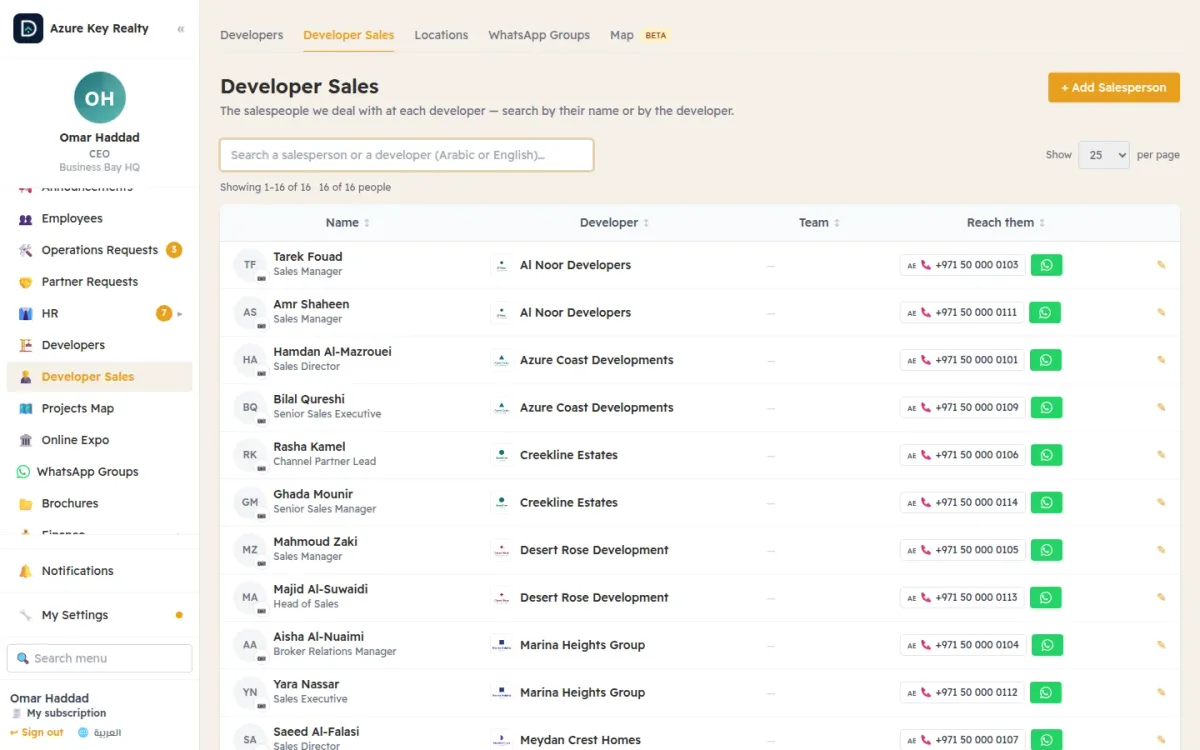
In Dealora, Developers & Projects holds developers, their projects, phases and files. Projects Map shows projects on a map with a project board and sends project files to a client. The Developer Sales index lists the salespeople at each developer with their numbers, so a broker can call or message the right contact. All three are on every plan.
Test 5: Does it fit REGA's brokerage paperwork?
Under the Real Estate Brokerage Law, brokerage or real estate services without a REGA licence are not permitted. The broker must register all brokerage contracts and real estate transactions on REGA's designated electronic platform. The brokerage contract must be in writing and for a definite term, and the broker must deposit a copy with REGA: a contract that is not deposited is unenforceable.
The Implementing Regulations add that brokers use the contract templates approved by REGA, deposit the contract on the platform after the parties approve it, and terminate it there within five business days of completing the transaction. A licensed broker creates the contract by logging in, picking the role (individual or business broker), opening Brokerage Contracts, creating a new contract for a buyer or tenant, entering the client and property details, and sending it to the client, who accepts or rejects it on the platform.
Failing to deposit or register contracts or completed transactions is a Class B violation: a warning, then a fine of SAR 300 per contract or transaction, then SAR 600, doubling if repeated within three years. The penalty scale can vary, so check REGA's current schedule.
The contract itself lives on REGA's platform, so your software does not replace it. What you test is whether your own records keep up: the client, the property, the salesperson who owns the deal, and a date or note that tells someone to terminate the contract within five business days. Ask the vendor to show where that status would live on a deal record, and try it with three real deals.
The licence also decides who needs a login. An establishment applying for a FAL licence needs:
- a valid commercial registration that includes the real estate brokerage activity (code 682010);
- a manager in charge who has completed REGA's qualification program (brokerage, marketing and e-marketing courses);
- the fee of SAR 1,000 per year.
An individual broker must be at least 18, hold a valid national ID, pass the same three courses, and pay SAR 300 per year.
Test 6: Does it cover the team and HR side?
Set up a manager and two salespeople. Check what each can see and edit, then try to hide one salesperson's clients from the other. The Employees module covers employees, departments and job titles, permissions, profile cards and Our Staff, and it is on every plan.
As the office grows, HR work moves out of chat groups and paper. Test the pieces you actually use, and note the plan each needs:
- Org Chart, the company hierarchy as a tree: Growth.
- Attendance & Leave, with mobile check-in and out, shifts and leave types: Business.
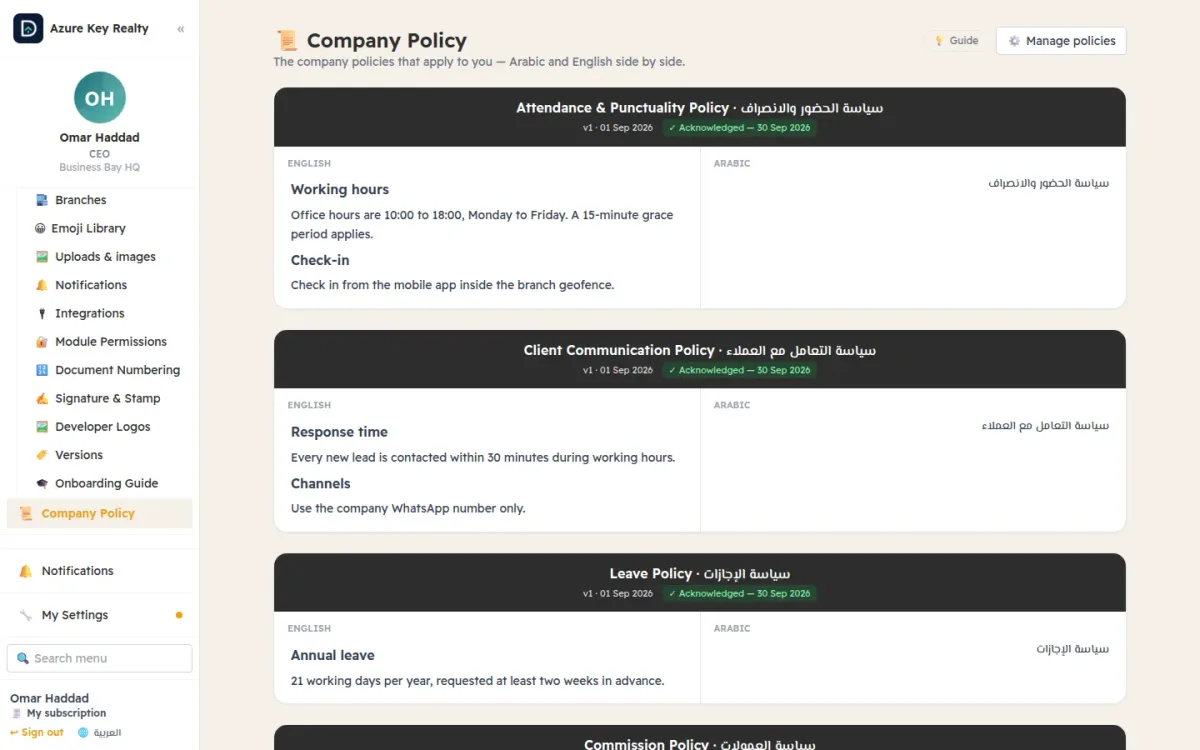
- Company Policy, policies every employee must read and acknowledge: Business.
- HR Requests, where employees ask for letters and certificates: Business.
- Bank Account Opening for new hires and Payroll: Enterprise.
For bilingual offices, check that a policy can be read in English and Arabic side by side and that the acknowledgement status is visible to management.
Test 7: Can management see spend, leads and sales?
Ask for one report that answers a simple question: which source brought the deals we closed this month? The CRM reports and sources cover the sales side on every plan. For marketing, the Marketing Dashboard shows spend to leads to sales, with cost per lead and return on ad spend, and is included from Growth.
If you run Meta campaigns, Meta Ads gives live campaigns, strategies built with AI and launch approvals, so nothing goes live without a person approving it. It is included on Enterprise, is an add-on from Growth charged as a monthly subscription, and works only with the company's own Meta connection. A bilingual dashboard matters here too: check that charts and labels read well in Arabic.
Test 8: What happens with users, export and add-ons?
Ask three plain questions: how many users the plan allows, whether you can export your data, and what extras cost. Starter allows up to 10 users with no data export. Growth allows up to 50, Business up to 150, and Enterprise has no user limit, all with data export. Past a plan's limit you add users or move up a plan; extra users are an add-on from Starter, as are extra storage, branches in other countries, Meta connection setup, a company website connected to the CRM, and White Label.
Data export decides how easy it is to leave, so ask early. Prices are on the Dealora pricing page, and the team can walk you through the right plan if you talk to Dealora through the contact page.
Test 9: What should you test in the free trial?
Every new Dealora company gets a 90-day free trial on the Starter plan. The trial holds Employees, CRM, Developers & Projects, Projects Map and the Developer Sales index, with no data export. That is enough to judge the core of a brokerage system. Use the 90 days in three blocks:
- Weeks 1-2: add your staff, set permissions, import or type in 50 real clients, and use the portal in Arabic daily.
- Weeks 3-6: enter the developers and projects you actually sell, send project files to clients, and record real deals through the pipeline.
- Weeks 7-12: run the weekly sales meeting from the CRM reports and ask each salesperson what they still do in a chat group or spreadsheet.
Anything outside the trial, such as the inbox or HR tools, is judged from its own page and a talk with the Dealora team about the plan that includes it. You can start the free Dealora trial from the product page.
How office size changes the answer
The same nine tests apply to every office, but the weight shifts with headcount. Individual is a separate plan for a solo broker or a tiny team of up to 3 users. It is not a step above Enterprise, so it sits outside the ladder below.
| Office | Test hardest | Dealora plan to look at |
|---|---|---|
| Solo broker or tiny team (up to 3 users) | Tests 2, 4 and 5: Arabic records, developer data, REGA paperwork | Individual (separate plan) |
| Small office (up to 10 users) | Tests 1, 2, 4 and 9 | Starter |
| Growing office (up to 50 users) | Tests 3 and 7: one inbox, spend to sales | Growth |
| Larger company (up to 150 users) | Test 6: HR and policies | Business |
| Company with no user limit | Tests 6 and 8: payroll, export, branches | Enterprise |
The full list of modules, with their plans and dependencies, is in every Dealora module by team, plan and dependency. If you want to see how the pieces fit as one system, Dealora's bilingual real estate CRM and ERP shows the whole portal.
Where to start this week
Pick the three tests that match your biggest daily pain, write down what a pass looks like, and run them with real clients. If your buyers reach you on WhatsApp or social media, include test 3. Then open a free account, use it for a week, and bring your results to the team. They can tell you which plan covers what you found missing.
Sources
Frequently asked
What software does a Riyadh property agency need?
A Riyadh agency needs a CRM for leads, clients and deals, a way to hold developer and project data, one inbox for WhatsApp and social messages, and team tools that match its size. It should work in Arabic and English, export your data when you leave, and let you test it with real work first.
Should real estate software for a Riyadh office be bilingual?
It should be if your clients, staff or developer materials use both Arabic and English. Check that screens mirror properly right to left, that Arabic names search correctly, and that Arabic and English text can sit in one record without breaking.
What does a FAL licence require in Riyadh?
A brokerage office needs a valid commercial registration that includes real estate brokerage (code 682010), a manager who has completed REGA's qualification program, and pays SAR 1,000 per year. An individual broker must be 18 or older, hold a valid national ID, pass the brokerage, marketing and e-marketing courses, and pay SAR 300 per year.
How long is Dealora's free trial and what does it include?
Every new Dealora company gets a 90-day free trial on the Starter plan. It includes Employees, CRM, Developers & Projects, Projects Map and the Developer Sales index. The Starter plan has no data export. Anything else is judged from its page and a talk with the Dealora team about the right plan.
Can a brokerage message clients on WhatsApp at any time?
Only users who opted in can be messaged. When a user writes or calls, a 24-hour customer service window opens and resets with each new message or call. Inside it, free-form service messages are allowed. After it closes, only pre-approved template messages can be sent.
Which Dealora plan suits a solo broker in Riyadh?
Individual is a separate plan for a solo broker or a tiny team of up to 3 users. It is not a step above Enterprise. It has no data export. A small office of up to 10 users would look at Starter instead, which is the plan the free trial runs on.
Related

Read next
- How to Set Up a Brokerage on Dealora: A Week-by-Week Checklist A two-week order for your first Dealora account: people and permissions, pipeline and sources, clients and lea
- Software for Dubai Property Agencies: 7 Tests Before You Buy A Dubai-specific checklist for choosing agency software: seven tests on your own client list, developer data,
- Dealora Features: Every Module by Team, Plan and Dependency A map of Dealora's 38 modules by the team that uses them: what each does, which plan includes it, what it depe
- Real Estate Drip Campaign: Build a Follow-Up Sequence A step-by-step build of a real estate drip campaign for new property leads: the trigger, five messages over 14