
Software for Dubai Property Agencies: 7 Tests Before You Buy
By Keys of Success Published Reviewed by Ali Darwish 10 min read
A Dubai-specific checklist for choosing agency software: seven tests on your own client list, developer data, WhatsApp replies, ad spend and team, and which of them fit inside a free trial.

Good software for Dubai property agencies holds clients, developers and projects, WhatsApp conversations, ad spend and HR in one system. Test it with your own data: import a real client list, find a developer's sales contact, reply on WhatsApp from the inbox, and trace one lead from ad to closed deal.
The right software for Dubai property agencies keeps clients, developers and projects, WhatsApp conversations, ad spend and staff in one system, and it proves that on your own data before you pay. A vendor's showcase proves little. A real client list, a real developer and a real ad campaign prove a lot. The seven tests suit an agency that sells off-plan, works with many developers, takes enquiries from ads and messaging apps, and runs a team that speaks more than one language.
Why a Dubai agency needs its own checklist
Dubai recorded 214,912 property sales transactions worth AED 682.5 billion in 2025, up 18.86% in volume and 30.7% in value on 2024. Off-plan project sales accounted for 132,500 of those transactions. In the third quarter of 2026, off-plan properties were 72% of Dubai residential sales transactions and 65% of sales value.
That mix changes what an agency needs from its system. In the same quarter, sales with the developer as a party were 74% of Dubai residential sales, so most deals an agency handles involve a developer. A CRM built only around a buyer and a seller leaves a gap: where do the developer, its projects, phases, payment plans and sales contacts live? If the answer is a spreadsheet and a set of chat groups, the agency has a CRM and a filing problem.
High enquiry volume adds a second pressure. Leads arrive from Meta ads, portals and direct messages, and the first reply decides a lot. The system has to put the conversation, the lead source and the salesperson on one record. A third pressure is people: a team that works in Arabic and English, with new joiners arriving often, needs HR and permissions inside the same portal rather than in a separate tool.
Keys of Success built Dealora, an AI-powered real estate ERP, for exactly this shape of company. Dealora is sold to real estate companies in Egypt, Saudi Arabia and the United Arab Emirates, and the portal runs in Arabic and English. The tests apply to any vendor, and each one notes how Dealora handles it. For a broader view of what to compare across vendors, see our real estate CRM comparison with eight checks.
Seven tests for software for Dubai property agencies
Run them in this order. Tests 1, 2, 3 and 6 fit inside Dealora's free trial, because they use modules on the Starter plan. Tests 4, 5 and 7 involve modules on higher plans, so the trial does not cover them; judge those from the module pages and a conversation with the Dealora team about the right plan.
Test 1: Import a real client list
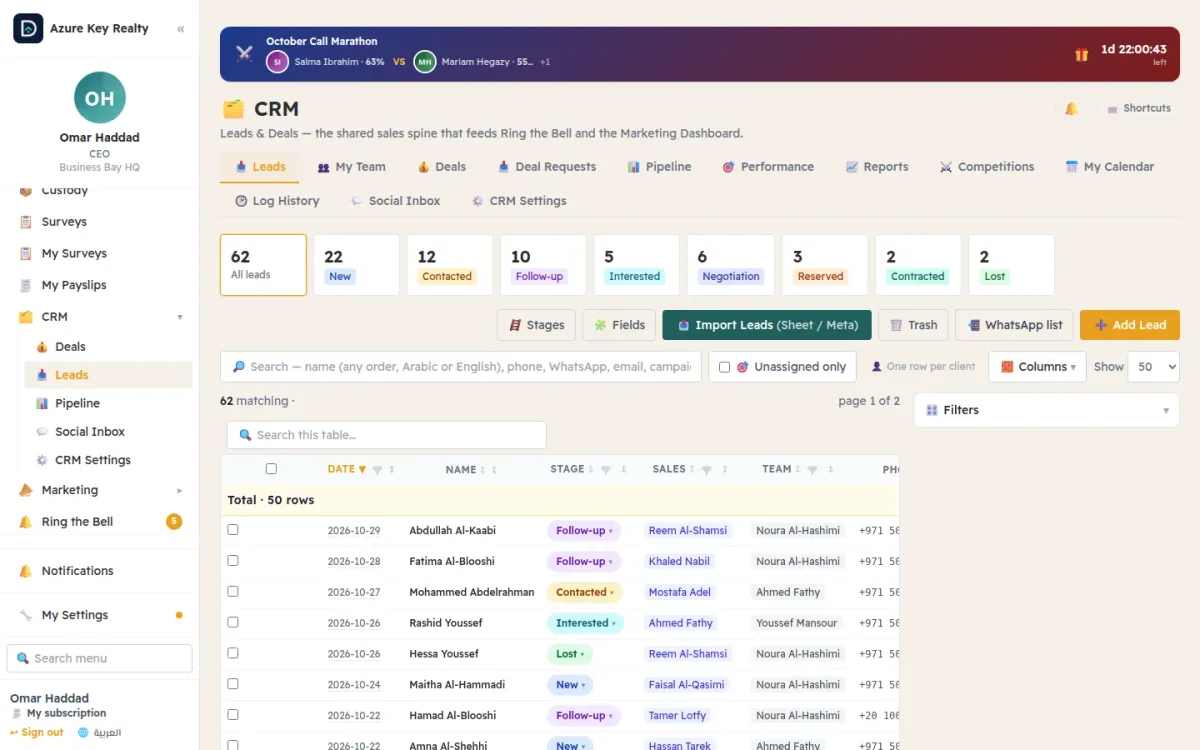
Take an export of at least a few hundred real contacts, not a tidy sample. Include the mess: duplicates, phone numbers typed with and without the country code, names in Arabic and in English, and a column for where each lead came from. Import it and check what happens to each problem. Does the system flag duplicates or silently create two records? Does the source survive the import? Can you filter by stage, salesperson and team afterwards?
In Dealora this is the CRM, which holds leads, clients, deals, the pipeline, sources and reports. It is on every plan, including Starter, so you can run this test in the trial. One more thing to ask on day one: how do you get your data out? Data export is part of Growth and above, and Starter has none, so decide early whether you need it.
Test 2: Find a developer's sales contact in under a minute
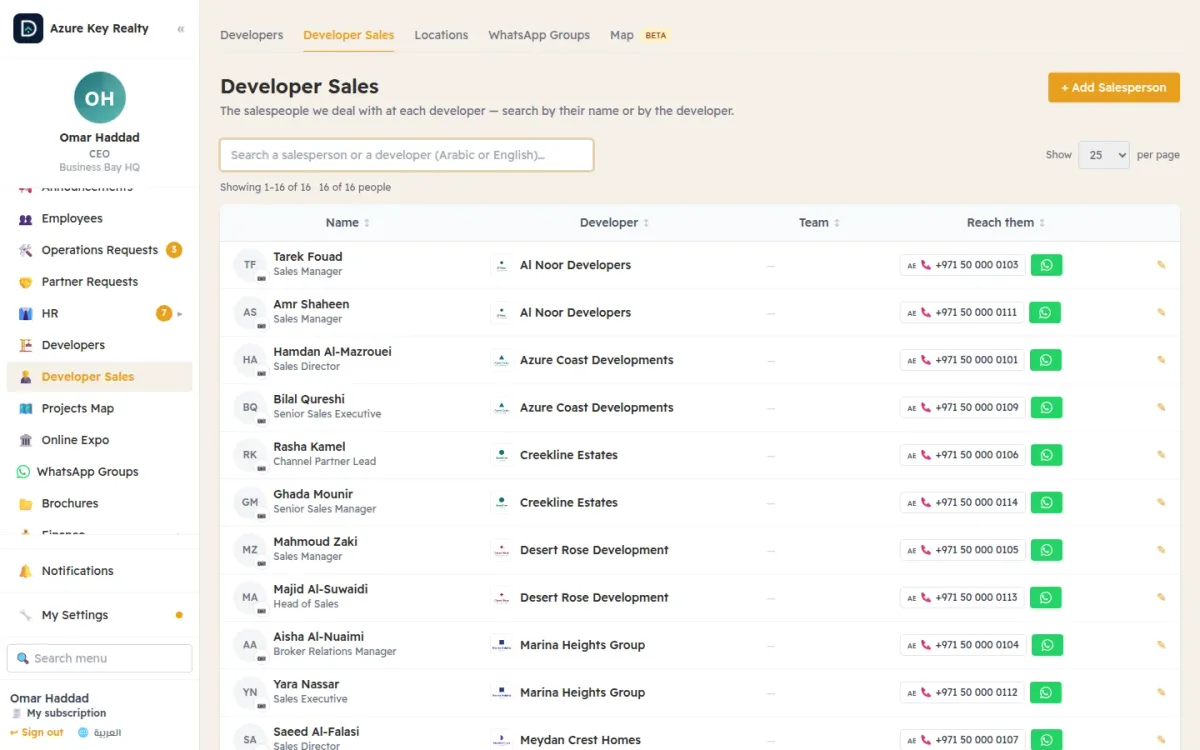
Pick a developer you work with every week and ask a salesperson to find the right person to call about a unit. Time it. If that contact lives only in a personal phone, it leaves with the employee. The test shows whether the system can hold developers, their projects, phases and files, and the salespeople at each developer, with a call or WhatsApp button next to each name.
Dealora covers this with Developers & Projects and the Developer Sales index, which lists the salespeople at each developer and their numbers. Both are on the Starter plan and in the trial. Add a dozen of your real developers and see whether a new joiner can find a contact without asking a colleague.
Test 3: Open a project and send its files to a client
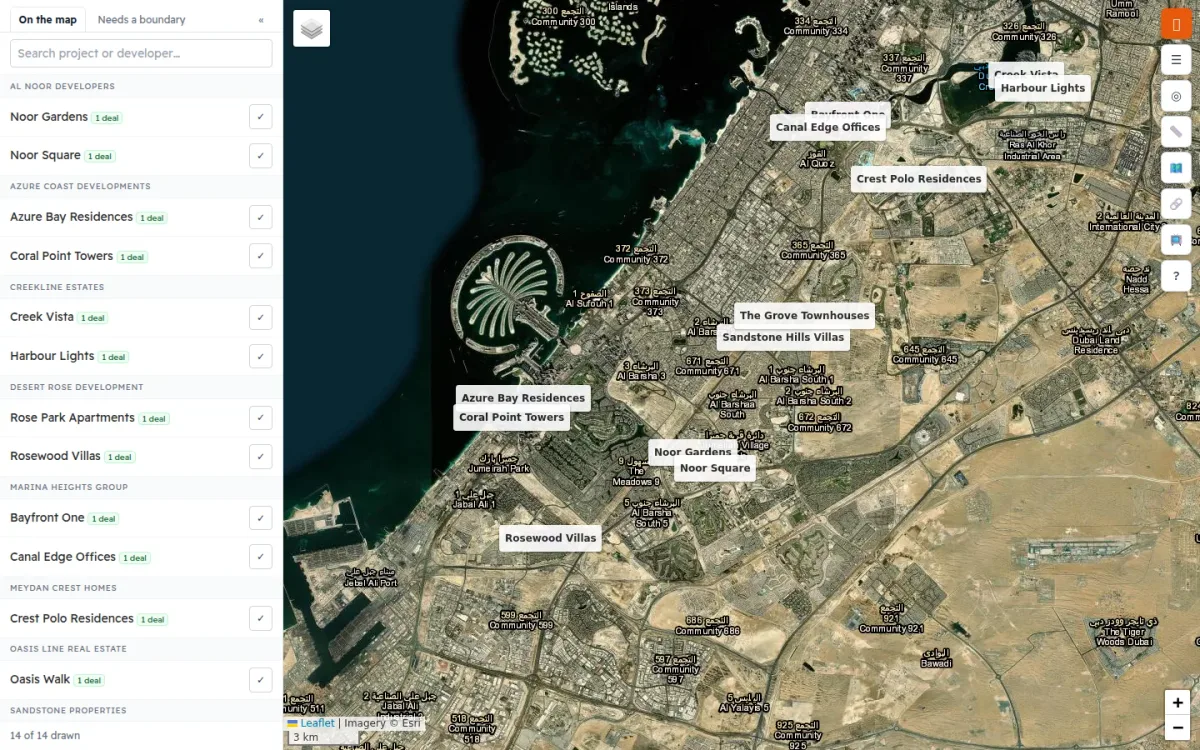
Off-plan selling is visual and file-heavy. Choose one project and check three things: can you see where it sits on a map, can you open its phases and files, and can you send those files to a client in a few taps from the same screen? If the salesperson has to leave the system to find a brochure, the files will end up in personal chats again.
The Projects Map in Dealora shows projects on a map, a project board and sending project files to a client. It is also on the Starter plan, so it belongs in your trial. Load the projects you actually sell this quarter, not sample data.
Test 4: Reply on WhatsApp from the inbox
WhatsApp is where a lead and a salesperson first meet in many sales teams, so test the inbox early. Send a message from a test phone and answer it from the system's inbox. In Dealora that is the Social Inbox, which is available from the Growth plan and is not part of the free trial. Check that the conversation is attached to the right lead and the right salesperson. Then check the rules your team will live with, because they shape how you work:
- When a customer messages or calls the business, a 24-hour customer service window opens, and it resets to 24 hours each time the customer writes again.
- Inside an open window you can send free-form service messages with no pre-approval. After it closes, only pre-approved template messages can be sent.
- A customer who messages from a Click-to-WhatsApp ad or a Facebook Page call-to-action button opens a 72-hour free entry point window if the business replies in time. Marketing, utility, authentication and service messages are not charged in it.
- The 24-hour window applies to messages sent through the Cloud API. Messages sent from the WhatsApp Business app are not subject to it and do not affect Cloud API pricing.
- Meta charges when a message is delivered, not when it is sent, based on who receives it and the message category. Since 1 October 2026 service messages and utility messages sent in response to users are charged per message. Rates vary by market, so check the current rate card for the UAE.
The Social Inbox brings Facebook, Instagram and WhatsApp messages inside the CRM, and it works only with the company's own Meta connection: its Facebook page, Instagram and WhatsApp Business number. Meta connection setup is available as an add-on from Starter. Because the inbox sits outside the trial, check how it handles your numbers on its page and in a talk with the Dealora team. If volume is the worry, the Chat Agent on Growth answers customers on Instagram, Messenger, WhatsApp and TikTok from the company's own knowledge, but it works only with the AI Sales Agent add-on and the company's own Meta connection, and it is charged by use.
Test 5: Trace one lead from ad to closed deal
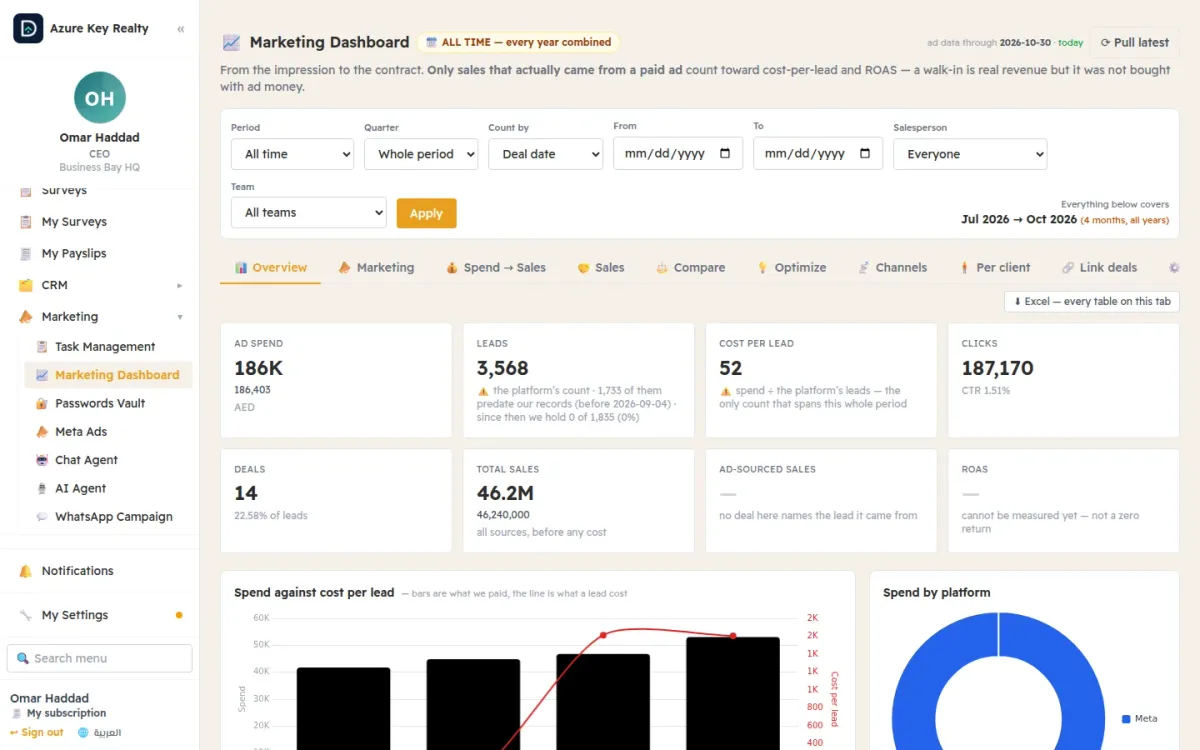
Choose a deal that closed last month and follow it backwards. Which ad or campaign produced the lead? Who answered it, how fast, and what happened at each stage? Then ask the system for cost per lead and cost per closed deal, which is the spend divided by the deals that closed. If the answer needs three spreadsheets and an afternoon, the system is not joining marketing to sales.
The Marketing Dashboard in Dealora shows spend to leads to sales, with cost per lead and return on ad spend. It is on Growth and above. The method behind it is laid out in a walkthrough of tracking leads from Meta Ads to closed deals. The test only works if the source is captured at the first touch, which is why Test 1 checks that the source survives an import.
Test 6: Check the team, the languages and the user count
Create accounts for a salesperson, a team leader, a marketing person and an administrator, in both languages your team uses. Dealora runs in Arabic and English; if your team needs another language in the interface, ask directly and test it rather than assuming. Check that permissions behave: a salesperson should see their own pipeline, a team leader the team's, and nobody should see what their role does not need.
Then count users. Starter covers up to 10 users, Growth up to 50, Business up to 150 and Enterprise has no limit. Past a cap you add users or move up a plan, since extra users are an add-on from Starter. Individual is a separate plan for a solo broker or a tiny team of up to 3 users; it is not a step above Enterprise. Employees, departments, job titles and permissions sit in the Dealora real estate ERP for brokerages on every plan.
Test 7: Check the back office, not only the sales floor
An agency that grows past a handful of people starts losing time to HR work: hiring, attendance, leave, letters, policies, new joiners. Ask the vendor to run one real HR task end to end, for example a new hire joining, and see whether it lives in the same portal as the sales data.
In Dealora these modules sit on higher plans. Attendance and leave, the hiring pipeline, employee lifecycle, HR requests and company policy are on Business and above, and payroll is on Enterprise only. They are outside the trial, so read each module's page and talk to the Dealora team about which plan matches your headcount. If this is where your agency is heading, the idea of one system for sales, HR and marketing is explained in an article on real estate software in the UAE by brokerage size.
Which tests fit inside the 90-day trial
Every new Dealora company gets a 90-day free trial on the Starter plan. It includes Employees, CRM, Developers & Projects, Projects Map and the Developer Sales index, and nothing else. The table maps each test to its module and plan.
| Test | Dealora module | Lowest plan | Where to run it |
|---|---|---|---|
| 1. Import a client list | CRM | Starter | In the free trial |
| 2. Find a developer contact | Developers & Projects, Developer Sales index | Starter | In the free trial |
| 3. Send project files | Projects Map | Starter | In the free trial |
| 4. Reply on WhatsApp | Social Inbox (needs the company's Meta connection) | Growth | Module page and a talk with the team |
| 5. Ad to deal | Marketing Dashboard | Growth | Module page and a talk with the team |
| 6. Team and users | Employees | Starter | In the free trial |
| 7. HR back office | Attendance, hiring, lifecycle, requests, policy (Business); Payroll (Enterprise) | Business or Enterprise | Module pages and a talk with the team |
How to score what you find
Give each test a plain result: passed with your real data, passed with workarounds, or failed. Do not average them. A system that fails Test 1 or Test 5 will cost you every week, while a missing nice-to-have costs you once. Ask the person who does the job, not the manager, to run each test, because they will hit the friction a manager skips.
Keep the notes in one place and compare them with what a lighter option would give you. If you are also weighing a Riyadh office, the same discipline applies there, and we wrote it up in nine tests for Riyadh property agencies.
A sensible first step
Start with the tests that cost nothing: export your client list, pick five developers and three live projects, and put them in the system. Create a free account for Dealora and start the 90-day trial, run Tests 1, 2, 3 and 6 with two salespeople, and write down what breaks. Then take Tests 4, 5 and 7 to the Dealora team with your numbers and your headcount, and ask which plan fits.
Sources
Frequently asked
What should software for a Dubai property agency include?
At minimum: a CRM for leads, clients and deals; a database of developers, projects and their sales contacts; a way to answer WhatsApp and social messages from the CRM; marketing numbers from ad spend to closed deals; and staff management. Off-plan agencies work with many developers at once, so developer data matters as much as the client list.
How do I test a real estate CRM in Dubai before buying?
Use your own data. Import a real client list with duplicates and Arabic and English names, find a developer's sales contact, open a project and send its files to a client, then follow one lead from the ad that produced it to the deal. Anything the system cannot do with your data will not improve after you pay.
What does the Dealora free trial include?
Every new company gets 90 days free on the Starter plan, which includes Employees, CRM, Developers & Projects, Projects Map and the Developer Sales index. Modules such as the Social Inbox and Marketing Dashboard are on Growth and above, so you judge them from their pages and a talk with the Dealora team.
Is Dealora available to agencies in the UAE?
Yes. Dealora is sold to real estate companies in Egypt, Saudi Arabia and the United Arab Emirates, and the portal runs in Arabic and English. It is an AI-powered real estate ERP built and run by Keys of Success, covering the CRM, developers and projects, marketing, HR and company administration.
Does WhatsApp charge for replies to customers?
It depends on the message type and the market. A customer message opens a 24-hour service window, and free-form replies inside it need no template. Since 1 October 2026 Meta charges per message for service messages and for utility messages sent in response to users, and rates vary by market. Messages are billed when delivered.
How many users does an agency need on the plan?
Count everyone who will log in: salespeople, team leaders, marketing and HR. Dealora's Starter plan covers up to 10 users, Growth up to 50, Business up to 150 and Enterprise has no limit. Past a cap you add users or move up a plan. Individual is a separate plan for a solo broker or a team of up to 3.
Related

Read next
- How to Set Up a Brokerage on Dealora: A Week-by-Week Checklist A two-week order for your first Dealora account: people and permissions, pipeline and sources, clients and lea
- Software for Riyadh Property Agencies: 9 Tests Before You Buy A buying checklist for a Riyadh brokerage office: nine tests for Arabic and English screens, client records, W
- Dealora Features: Every Module by Team, Plan and Dependency A map of Dealora's 38 modules by the team that uses them: what each does, which plan includes it, what it depe
- What Is Dealora? A Plain Guide to the Real Estate Portal Dealora is the AI-powered real estate ERP built and run by Keys of Success. Here is who it is for, what each m