
Real Estate Lead Qualification Questions: 8 to Ask Before a Viewing
By Keys of Success Published Updated Reviewed by Ali Darwish 13 min read
Eight questions a broker can ask in the first call or WhatsApp chat: why each matters, how to word it, what a serious answer sounds like and where to record it in the CRM.

Eight real estate lead qualification questions cover budget and payment method, purpose, timeline, decision makers, area and unit needs, previous viewings, financing status and preferred contact. Ask them in conversation during the first call or chat, record each answer on the lead's CRM record, and book a viewing once the key answers are clear.
The real estate lead qualification questions that matter most are eight: budget and payment method, purpose, timeline, decision makers, area and unit needs, previous viewings, financing status and preferred contact. Ask them in the first call or WhatsApp chat, in conversation and not as a form, and write each answer on the lead's record before you move on. A buyer who answers most of them clearly is ready for a viewing. A buyer who cannot answer one or two needs a dated follow-up first.
Why qualify a lead before booking a viewing
A viewing costs an agent and the buyer time. If the budget does not fit the unit or the person who decides is not coming, that time is wasted on both sides. Qualifying first protects the diary and lets you spend viewing slots on buyers who can actually move.
Speed matters just as much as the questions. A 2011 Harvard Business Review article by James Oldroyd, Kristina McElheran and David Elkington reported two findings. In an audit of 2,241 US companies, 37% answered a web lead within an hour, 23% never answered, and the companies that did answer took 42 hours on average. In a separate analysis of 1.25 million leads at 42 US companies, firms that tried to contact a lead within an hour were nearly seven times as likely to qualify it as firms that waited even one hour longer. The lesson for a brokerage is to make the first contact quickly and keep the questions short enough to ask in one sitting.
Keep a simple rule for the whole team: the answers belong to the company, not to the agent who asked. That means they live in a shared CRM that holds leads, clients, deals and sources, in the same place for everyone.
The eight questions at a glance
Use this table as the checklist on your desk. The sections after it give the wording and the reasoning for each row.
| Question | A serious answer sounds like | Record on the lead |
|---|---|---|
| 1. Budget and payment method | A range, plus how they will pay | Range, payment method, source of down payment |
| 2. Purpose | A clear reason: live in or invest | Purpose and what success looks like |
| 3. Timeline | A date or an event that sets it | Target month and the reason behind it |
| 4. Decision makers | Names who else decides and when they can join | Who decides, who must see the unit |
| 5. Area and unit needs | Specific areas, size, must-haves | Shortlist criteria and dealbreakers |
| 6. Previous viewings | Can describe what they saw and why they said no | Projects seen, other brokers involved |
| 7. Financing status | Knows the loan route and has started it | Cash, mortgage or instalments, approval stage |
| 8. Preferred contact | Names a channel and a time | Channel, time window, language |
The eight real estate lead qualification questions, one by one
Every question below follows the same four parts: why it matters, how to phrase it, the answer that signals a serious buyer, and where to record it.
1. Budget and payment method
Why it matters. Budget decides which projects are even worth mentioning. The payment method matters as much as the figure, because a buyer paying cash, a buyer taking a mortgage and a buyer relying on a developer's instalment plan are in three different conversations.
How to phrase it. "What price range feels comfortable for you, and are you thinking of paying cash, using a mortgage or spreading it over instalments?" If the buyer hesitates, offer two or three bands and ask which is closest.
The serious answer. A range with a reason, such as "up to this much, because that is what we have saved and what the bank indicated". Vague answers like "depends on the unit" are not bad, but they mean the budget is not yet defined.
Record it. Write the range, the payment method and where the down payment comes from, in plain words on the lead's record.
2. Purpose: living or investing
Why it matters. A family buying a home cares about the school run and the neighbors. An investor cares about yield, resale and the payment plan. Pitching the wrong angle loses the buyer in the first minute. Our article on how to tell and pitch an investor and an end user goes deeper into the difference.
How to phrase it. "Is this for your family to live in, or are you looking at it as an investment?" Follow with "What would make this purchase a success for you in five years?"
The serious answer. A concrete purpose with a picture attached: "We need three bedrooms near my wife's work" or "I want something I can rent or resell". Buyers who say "just looking at options" may still be serious, but the purpose is not settled yet.
Record it. Record the purpose and the success statement in the buyer's own words. If your team tags buyers by segment, apply the tag now; our guide to six buyer segments and how to tag them shows how.
3. Timeline
Why it matters. Timeline separates a buyer who needs a decision this quarter from one who is collecting ideas for next year. It also tells you what to show: ready units for a buyer who must move soon, off-plan for one who can wait.
How to phrase it. "When would you like to be signed or moved in?" If the answer is open, ask "Is there anything that sets the date, such as a lease ending, a bonus or a school year?"
The serious answer. A date or an event behind it. A deadline with a reason is stronger than a short deadline with none.
Record it. Record the target month and the reason, then set the follow-up date on the same day.
4. Decision makers
Why it matters. Many deals stall because the person on the phone is not the only one who decides: a spouse, a parent who contributes, a business partner. If they have not seen the unit, the second viewing becomes the first.
How to phrase it. "Who else will be part of the decision, and would it help to arrange the viewing when they can join?" This sounds helpful, not like an interrogation.
The serious answer. The buyer names the others and offers a time when they are free. A buyer who says "it is only me" and means it is simpler still.
Record it. Note who decides, who must see the unit and any person who controls the money.
5. Area and unit needs
Why it matters. This is where you separate a real shortlist from a wish list. It also stops you sending twenty irrelevant listings, which teaches the buyer to ignore your messages.
How to phrase it. "Which areas are you considering, and what are the two or three things the unit must have?" Then ask the reverse: "Is there anything that would rule a unit out immediately?"
The serious answer. Named areas, a size, a floor or finish preference and at least one dealbreaker. Specific refusals are a good sign because they show the buyer has already compared.
Record it. Record the areas, size, must-haves and dealbreakers as a short list so any agent can pick up the search.
6. Previous viewings
Why it matters. A buyer who has already seen projects has opinions you can use, and may already be talking to another broker. Knowing what they rejected, and why, saves you from repeating it.
How to phrase it. "Have you already visited any projects? What did you like, and what put you off?" Add, gently, "Are you working with another broker at the moment?"
The serious answer. A buyer who can describe a project by name and explain the no. In Dubai, also ask whether they have signed anything, especially a buyer-broker agreement (known as Form B), which sets the contract duration and the commission. Find out whether one exists and when it ends before you invest time.
Record it. Record the projects seen, the reasons for rejecting them and any other broker or agreement.
7. Financing status
Why it matters. Financing is where good-looking leads collapse. A buyer who needs a mortgage but has not spoken to a bank is a different prospect from one with approval in hand.
How to phrase it. "Have you spoken to a bank or a developer about the financing yet, and where are you in that process?" Do not ask for documents on the first call. You only need the stage.
The serious answer. The buyer knows the route and has taken a first step: a pre-approval request, a calculation, or confirmed cash. Knowing the local rules helps you judge whether the budget is realistic. These vary by bank, buyer status and date, so confirm current figures with the bank before promising anything.
- UAE. Within UAE Central Bank caps, banks lend up to 80% of the value to an expatriate buying a first home, so the down payment starts at 20%, and up to 85% to a UAE national (15% down). The caps are lower for higher-value properties, for a second or investment property and for off-plan units, and buyers without UAE residency usually need a much larger down payment. A debt burden cap also limits how large a loan a buyer can get, so ask the bank for the current figures.
- Egypt. Under the Central Bank of Egypt mortgage initiatives, new loans issued from 15 October 2025 carry an 8% declining rate in the low-income initiative and 12% declining in the middle-income initiative; loans issued earlier keep their old rates. Each bank sets the detailed terms. At Banque Misr, for example, the 12% middle-income loan runs up to 25 years and up to EGP 2 million, for a unit priced up to EGP 2.5 million, for net monthly income up to EGP 40,000 for a single applicant or EGP 50,000 for a married applicant, and the instalment can be up to 40% of net monthly income.
- Saudi Arabia. Under Saudi Central Bank (SAMA) rules, banks can finance up to 90% of the value of a citizen's first home, so the minimum down payment is 10%, and up to 70% for a second home or beyond (30% down). SAMA's responsible lending rules also cap total monthly debt payments as a share of salary. Sakani, through the Real Estate Development Fund, supports eligible Saudi citizens buying a first home with subsidised financing, and eligibility is checked on the Sakani platform.
Record it. Record the route (cash, mortgage or instalments) and the stage: not started, in discussion, pre-approved. That one line tells the next agent how much time the lead needs before a viewing makes sense.
8. Preferred contact
Why it matters. A buyer who prefers WhatsApp in the evening will not answer a call at noon, and you will read that as lost interest. Asking also gives you a clean basis for later messages.
How to phrase it. "What is the best way and time to reach you, a call or WhatsApp, and is Arabic or English easier?" Add "Is it all right if I send you options and updates there?"
The serious answer. A channel, a time window and a yes. On WhatsApp the rules shape what you can do next. A business can send free-form replies only within 24 hours of the customer's last message or call, and each new customer message resets the 24 hours. Outside that window only Meta-approved templates can be sent. A customer who messages first has not given opt-in for business-initiated messages later. Since the November 2024 policy update the opt-in can be general rather than specific to WhatsApp, but it must name the business, so word your question so that your company name is in it.
Record it. Record the channel, time window, language and whether the buyer agreed to updates. When chats from Facebook, Instagram and WhatsApp land in one place, such as a social inbox inside the CRM, the conversation and the record stay together, and our article on turning WhatsApp chats into deals shows how brokers handle them.
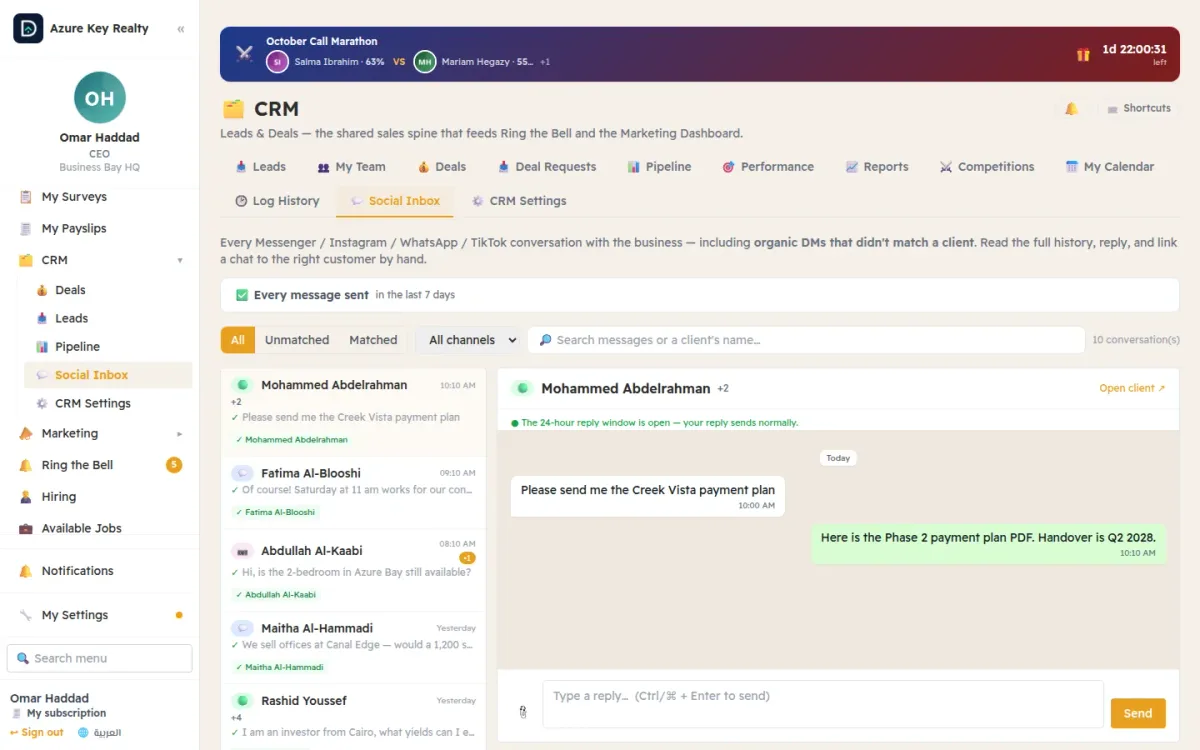
How to ask without it feeling like a form
Order the questions by how comfortable they are, not by the table. Start with area and purpose, which buyers enjoy talking about. Move to timeline and decision makers, then to budget and financing once there is some trust. Preferred contact comes last, as a natural way to end the call.
- Ask one question at a time, especially on WhatsApp, and acknowledge each answer before the next.
- Let buyers volunteer answers. If they mention a spouse in passing, mark decision makers as answered.
- Give a reason when asking something personal: "so I only send you units that fit".
- Stop when the buyer tires. Unanswered questions become the reason for the next contact.
Where to record the answers so the next agent sees them
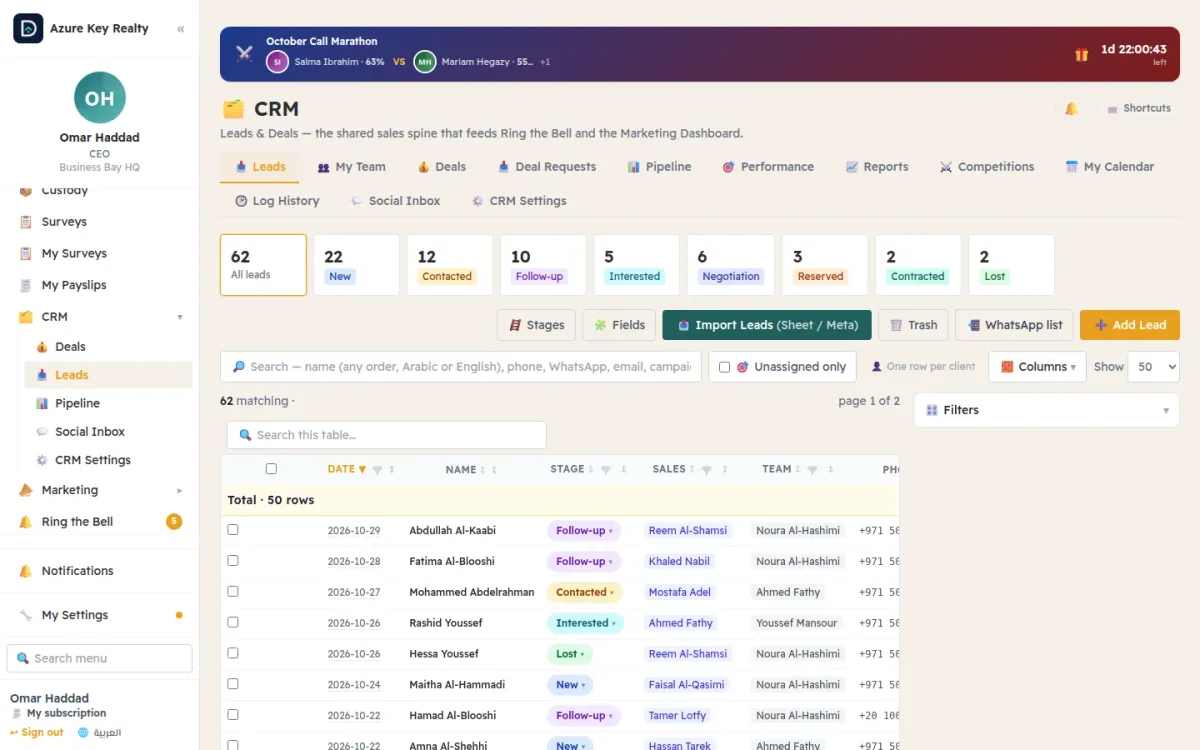
Qualification fails quietly when the answers stay in one agent's head or in a private chat. Agree one place for each answer and use it every time. On the lead's record, write short, plain sentences with the date, for example "Budget: up to this range, mortgage, pre-approval not started. Purpose: family home. Wants to move before the school year."
A good test is simple: could a colleague who has never spoken to this buyer open the record and run the next call? If not, the record is missing something. When a lead is assigned or reassigned, the answers travel with it. If you are choosing a system for this, real estate CRM software built for brokerages keeps leads, clients and deals in one portal, and Dealora, the real estate ERP Keys of Success built and runs, is one example.
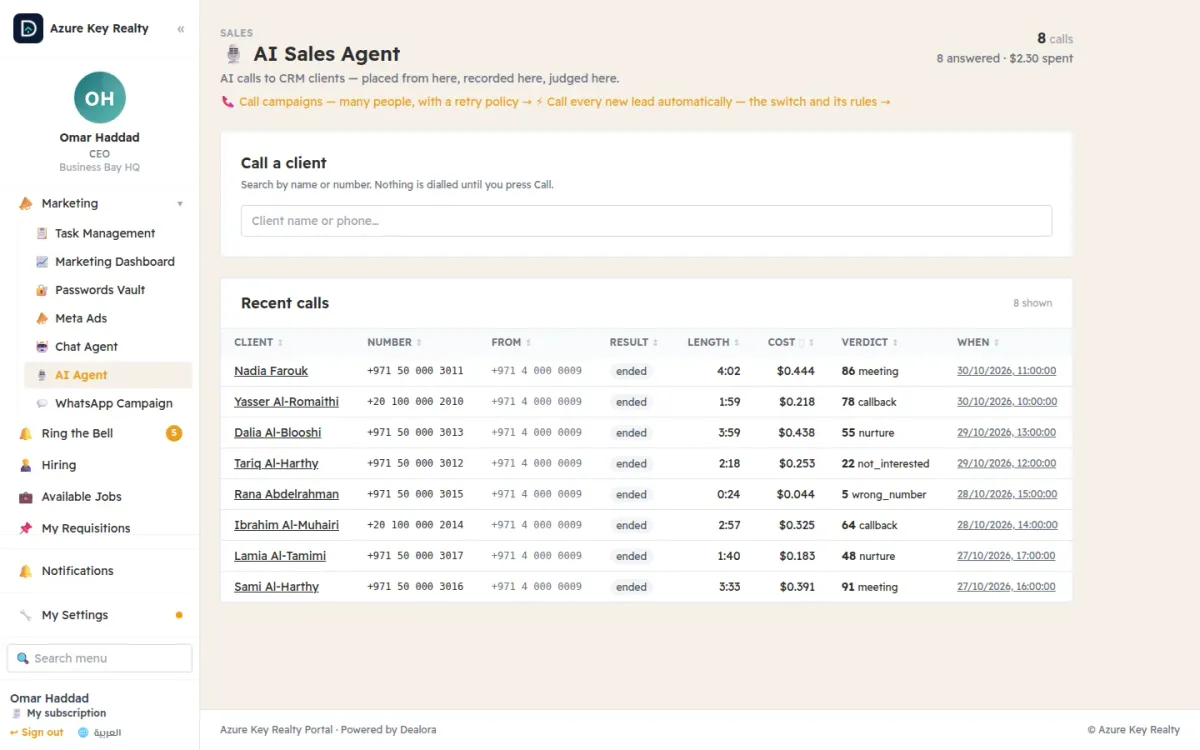
Calls can be recorded too. The AI Sales Agent phones clients and keeps the recording and a verdict on each call, so the next person can listen to what was said before calling back. Calls cost by usage.
When to book the viewing and when to nurture instead
Skip the hot, warm and cold labels. Look at the answers themselves and ask whether the viewing can produce a decision.
Book the viewing when
- The budget and payment method fit at least two units you can show.
- The purpose and the area and unit needs match what you have.
- The timeline has a date or a reason behind it.
- The decision makers can attend, or the buyer has said when they can.
- Financing has started, or the buyer is paying cash.
When these hold, book quickly, confirm in the channel the buyer chose, and send the location and the agent's name.
Nurture instead when
- The budget is unclear or does not fit anything you have. Send options across price bands and watch which one gets a reply.
- The decision maker is missing. Offer a time when everyone can come instead of a solo visit.
- Financing has not started. Share the steps and a reasonable date to check back.
- The timeline is a year or more away. Set a follow-up tied to their event, not a generic "just checking in".
Nurturing is not waiting. Every nurture contact should carry something new: a matching unit, an updated payment plan, a developer announcement. Give the follow-up a date and an owner, and move the lead through your real estate sales pipeline stages with clear exit rules so it does not sit untouched.
To start, print the eight questions, use them on your next ten leads and see which answers your team keeps failing to capture. If you want help setting up the fields and follow-up rules in your own system, talk to the Keys of Success team.
Sources
Frequently asked
What questions should I ask a property buyer before a viewing?
Ask about budget and payment method, whether the purchase is to live in or invest, the timeline, who else decides, the area and unit needs, viewings already done, financing status and the preferred way to be contacted. Eight short questions are enough to decide whether a viewing is worth booking.
How do I qualify a property lead on WhatsApp?
Keep each message to one question, start with something easy such as the area, and reply within the 24-hour window so free-form messages are allowed. Record every answer on the lead's CRM record. If the lead stops answering after the budget question, move to a dated follow-up.
How many questions are too many in a first call?
If the call feels like a form, the buyer stops answering. Weave the eight questions into a normal conversation, let the buyer volunteer answers, and ask only what is still missing. Anything left unanswered becomes the topic of the next contact, not a reason to push.
Should I ask about budget straight away?
Ask after you have shown interest in what the buyer wants, not as the opening line. Start with the area or the type of unit, then ask for a comfortable range and how they plan to pay. A range with a payment method is more useful than a single figure.
What should I do if the buyer will not share their budget?
Offer two or three price bands and ask which feels closest. Many buyers answer a choice more easily than an open question. If they still decline, record that, send options across the bands and see which one they react to.
Where should qualification answers be recorded?
On the lead's record in the CRM, in the same place for every agent, written in plain words with the date. The next agent should be able to open the record and understand the buyer in under a minute without calling to re-ask.
Related

Read next
- Real Estate Drip Campaign: Build a Follow-Up Sequence A step-by-step build of a real estate drip campaign for new property leads: the trigger, five messages over 14
- All in One vs Separate Real Estate Software: How to Decide Five apps for CRM, WhatsApp, ad reports, HR and files cost a brokerage hours of re-typing and lost lead histor
- Lead to Deal Conversion Rate: How to Calculate It by Stage A step-by-step method to calculate your lead to deal conversion rate: fix the counting rules, follow one cohor
- Real Estate Buyer Persona Template: 4 Fields and CRM Tags A fill-in persona card for brokerages: four fields (budget, location, purpose, timeline), five worked examples