
Property Investor vs End User Buyer: How to Tell and Pitch Each
By Keys of Success Published Updated Reviewed by Ali Darwish 10 min read
An investor buys a number and an end user buys a life. Here is how brokers in Egypt and the Gulf spot each buyer, change the first call and shortlist, and tag the type in the CRM.

A property investor buys for return: rental yield, payment plan terms, resale and exit costs. An end user buys to live: layout, location, school, commute and handover date. Brokers should identify the type on the first call, tag it in the CRM, and change the shortlist and follow-up to match.
The property investor vs end user buyer question comes down to one thing: what the property is for. An investor buys a return and plans an exit, so the conversation is about yield, payment plan and resale. An end user buys a place to live, so it is about layout, location, school, commute and the day the keys arrive. A broker who treats both the same way sends the wrong units, quotes the wrong numbers and loses the buyer to someone who listened.
Property investor vs end user buyer: the core difference
Both buyers can fall in love with the same tower. What separates them is the test they apply before they say yes. The investor asks whether the numbers still work after costs and whether they can get out. The end user asks whether the family will be happy there in three years.
These are the real estate buyer motivations that sit behind almost every question you will hear:
- Investor: income or capital growth, a payment plan that keeps cash free, and a way out that does not depend on luck.
- End user: a home that fits daily life, a monthly payment the household can carry, and a handover date they can plan around.
What each buyer asks and which numbers they trust
The table shows the questions that separate end user vs investor real estate conversations, and the figures each buyer wants on the table.
| Topic | Investor | End user |
|---|---|---|
| First question | What is the down payment and how long are the installments? | How many bedrooms, and what does the layout look like? |
| Key number | Rental yield, total cost after fees, resale value | Monthly installment against household income |
| Payment plan vs layout | Plan matters more than layout | Layout matters more than plan |
| Location | Demand from tenants and future buyers | School, commute, family, services nearby |
| Timing | Handover and the moment to sell or rent | Move-in date and rent they stop paying |
| Main worry | Getting stuck with a unit they cannot sell | Delays and a unit that is not as shown |
Rental yield: quote it carefully
Yield is the investor's favorite number and the easiest one to get wrong. Published figures for residential rental yield in Egypt vary with the source, the city and whether the figure is gross or net. Global Property Guide, for example, puts the national average gross yield at 7.61% for the second quarter of 2026. That is a nationwide figure before costs, so a given city or compound can sit well above or below it.
So never promise a yield. Give a range, say where it comes from and whether it is gross, and remind the buyer that resort units carry management fees that can noticeably cut net yield. That honesty is what makes a serious investor trust the rest of your numbers.
Resale: the question investors ask last and care about most
In Egypt, resale sellers usually ask for cash or a large upfront payment, while developers offer long installment plans. That makes it hard for a resale seller to compete with a developer, and it makes exit the central question for an investor. A weak exit layer matters far more to an investor than to an end user who intends to stay.
Dubai shows the same logic at larger scale. Off-plan units make up a large share of Dubai's residential sales, and developer payment plans there usually carry no interest charge, which appeals to buyers who plan to sell before or shortly after handover as well as to people who will live in the unit. Market shares move from period to period, so check current Dubai Land Department data before you quote a figure.
How to identify a property investor on the first call
Knowing how to identify a property investor takes four questions, asked in a relaxed order. Do not ask "are you an investor?" because many buyers answer with what sounds respectable rather than what is true.
- "Who will use the property?" An investor says tenants, or nobody for now. An end user says the family.
- "How long do you plan to keep it?" A holding period of a few years, or "until handover", points to an investor.
- "What matters more, the payment plan or the layout?" The answer is usually immediate and honest.
- "Have you bought off-plan before?" Experience with installments and handover delays is a strong investor signal.
Listen also for vocabulary. Words like yield, flip, exit, down payment, deferred first installment and price per square meter against the area point to an investor. Words like school, parents nearby, garden, parking and "when can we move in" point to an end user. For a wider set of segments beyond these two, see our article on the types of clients in real estate and how to tag them.
End user property buyer questions to prepare for
End user property buyer questions are practical and personal, and a salesperson who only knows the unit's price per meter will struggle. Prepare answers for these:
- How long is the commute to work and to the children's school at peak hours?
- What is the layout, and where do the light and the noise come from?
- Can our monthly income carry the installment, and what happens if it rises?
- When is handover, and what happens if it is late?
- What are the neighbors and services like once the project is occupied?
The end user also wants proof that the project exists and is moving. Show phases, progress and the developer's other projects rather than yield tables.
What changes between Egypt and the Gulf
The two buyer types appear in both markets, but the payment structures and costs differ, and the broker has to explain them before the buyer asks.
Egypt: payment plans and costs
Developers in Egypt commonly ask for a 5-10% down payment followed by installments over 5-10 years, often interest-free. This varies by developer and project. By buyer type, the usual fit is:
- Extended plans (5-10% down, up to 10 years, first payment deferred 1-2 years) suit investors who want to stretch their capital.
- Standard plans (10% down, quarterly installments over 5-8 years) suit salaried buyers.
- Construction-linked plans suit risk-averse off-plan buyers.
Costs matter at resale. The real estate disposal tax is 2.5% of the gross sale value and falls on the seller, so an investor should include it when calculating the cost of reselling. Since 29 July 2026, the tax must be remitted within 60 days of the disposal. On the buying side, registration, notary and legal fees add to the purchase price, and the agent's commission is often paid by the seller. These costs vary by deal, so confirm them each time.
Dubai: fees an investor will calculate
The Dubai Land Department registration fee is 4% of the sale value, scheduled as 2% for the seller and 2% for the buyer, although contracts often place the whole amount on the buyer. Off-plan purchases are registered through Oqood, where the 4% is paid, and it is not charged again when Oqood converts to the final title deed. The trustee office fee is AED 4,000 for sales of AED 500,000 or more and AED 2,000 below that, plus 5% VAT. Buyers who take a mortgage pay a registration fee of 0.25% of the loan amount.
Pitching to property investors: first call, shortlist, follow-up
Pitching to property investors is mostly about arithmetic. The first call has to give them numbers they can use, not a description of the lifestyle.
The first call
Ask about budget and what share is down payment, how long they plan to hold, and whether they want rent or a resale profit. Then tell them the payment plan structure, the total cost with fees, and what the exit looks like. If you do not know the resale picture for a project, say so and promise to come back with it.
The shortlist
Send two or three units, not ten, each with the same cost table: down payment, installment schedule, fees, expected rent range with its source, and a realistic resale note. Mix at most one stretch option. A comparison of the same numbers across units does the selling for you.
Brochures: one current version for every investor
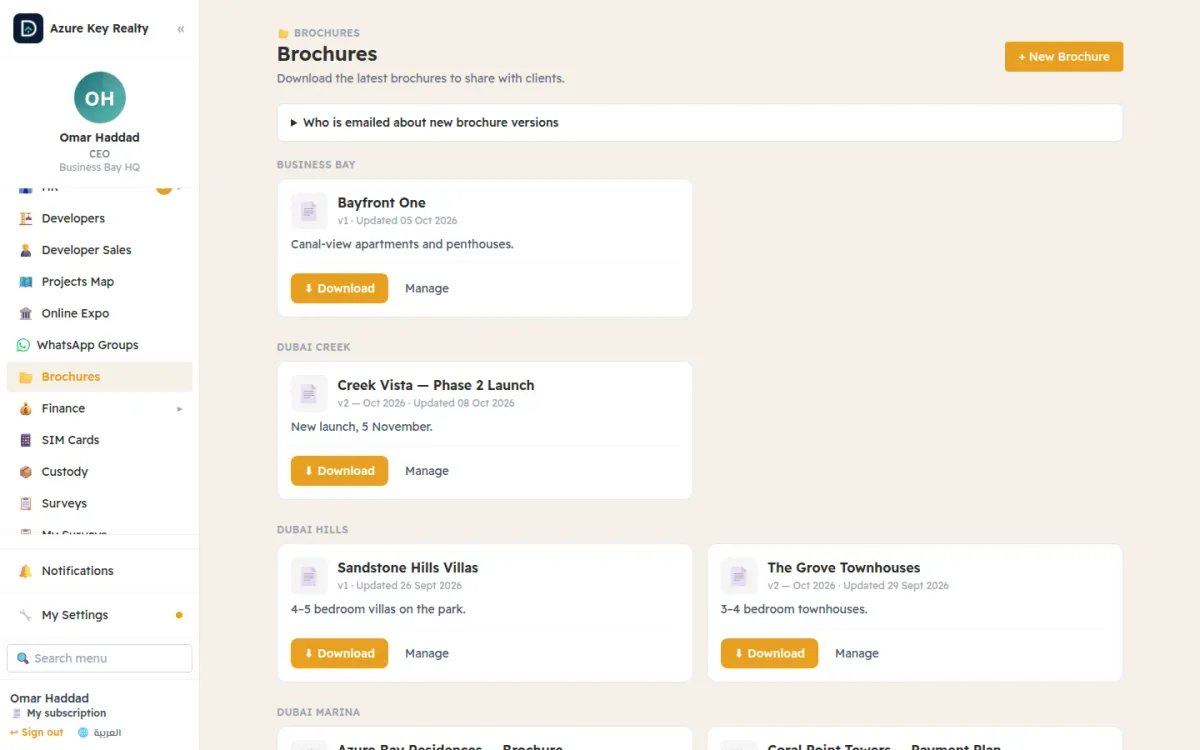
Brochures help, provided everyone sends the current version. A shared library of PDF brochures for the sales team removes the risk of an investor receiving an outdated plan from one salesperson and a new one from another.
The follow-up
Investors respond to new information, not to "just checking in". Follow up with a change in the payment offer, a new release, or a resale comparison. Keep each message short and tied to one number, and move the conversation to a call once they ask about terms.
Pitching to end users: what to change
With an end user the order flips. Start with the household, not the price. Ask who will live there, where they work, where the children study and what they pay in rent now. Then choose units by layout and location, and show the payment plan as a monthly figure they can compare with their rent.
The location story is easier to tell visually. A projects map with the project board and file sending to a client lets the salesperson show how far each project is from the areas that matter to the family, then send the project files in the same conversation. Follow-up for end users is about visits: offer a site visit, a sample unit or a second viewing with the spouse or parents, because these are shared family decisions.
The developer sales index: answers for both buyer types
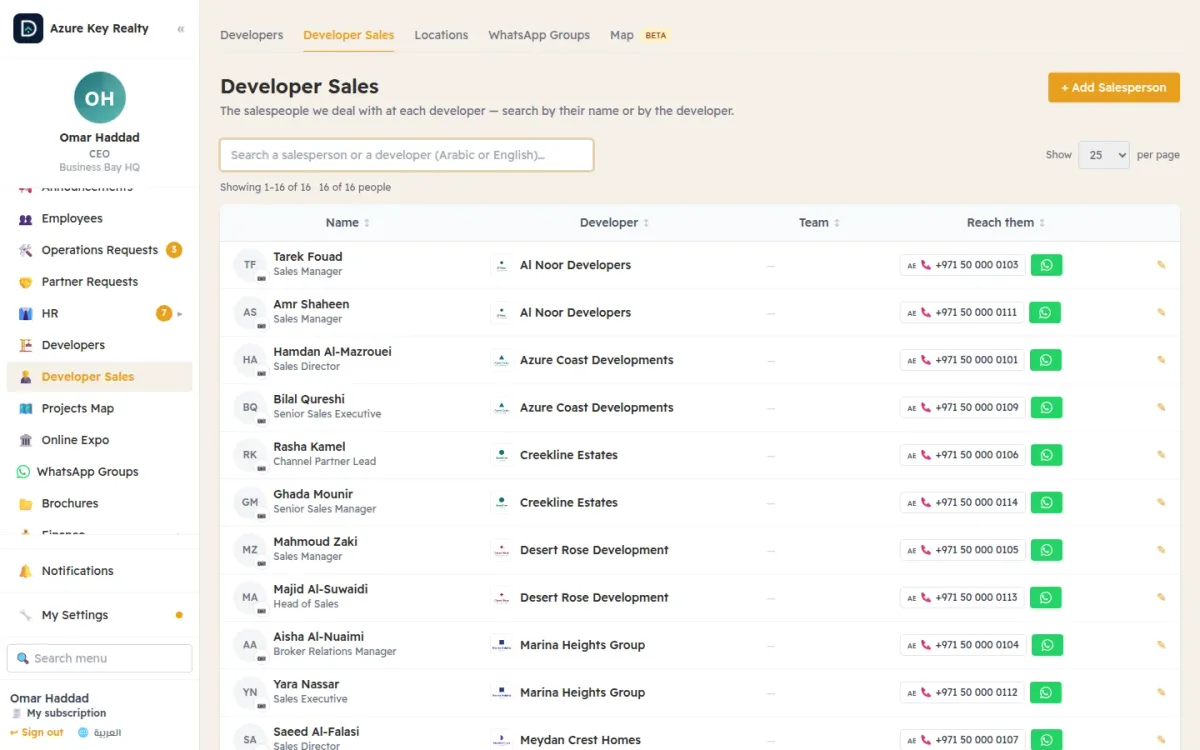
Both buyer types ask questions you may not be able to answer alone, such as handover status or the current plan. Having the developer's sales contacts at hand, as in a developer sales index, shortens the wait for both of them.
How to tag the buyer type in the CRM
A pitch only becomes consistent when it is attached to the record. Tagging the buyer type in the CRM means the next salesperson, or the same one next month, opens the lead and knows which script to follow. The steps below work in any CRM. In the CRM, leads, clients, deals and the pipeline live together:
- Choose three labels only: investor, end user and mixed. Add more segments later, once these are used reliably.
- Make the tag part of the first-call checklist. A lead is not qualified until the salesperson has asked the four questions and recorded the answer.
- Write the reason in a note. "Plans to hold 3 years, asked about deferred first payment" is more useful than the tag alone.
- Agree a follow-up for each tag. Investor leads get a cost table and a resale comparison; end user leads get a site visit offer and layout files.
- Review by tag. Compare conversion and time to close for investors and end users by source and pipeline stage, then adjust the pitch where a group stalls.
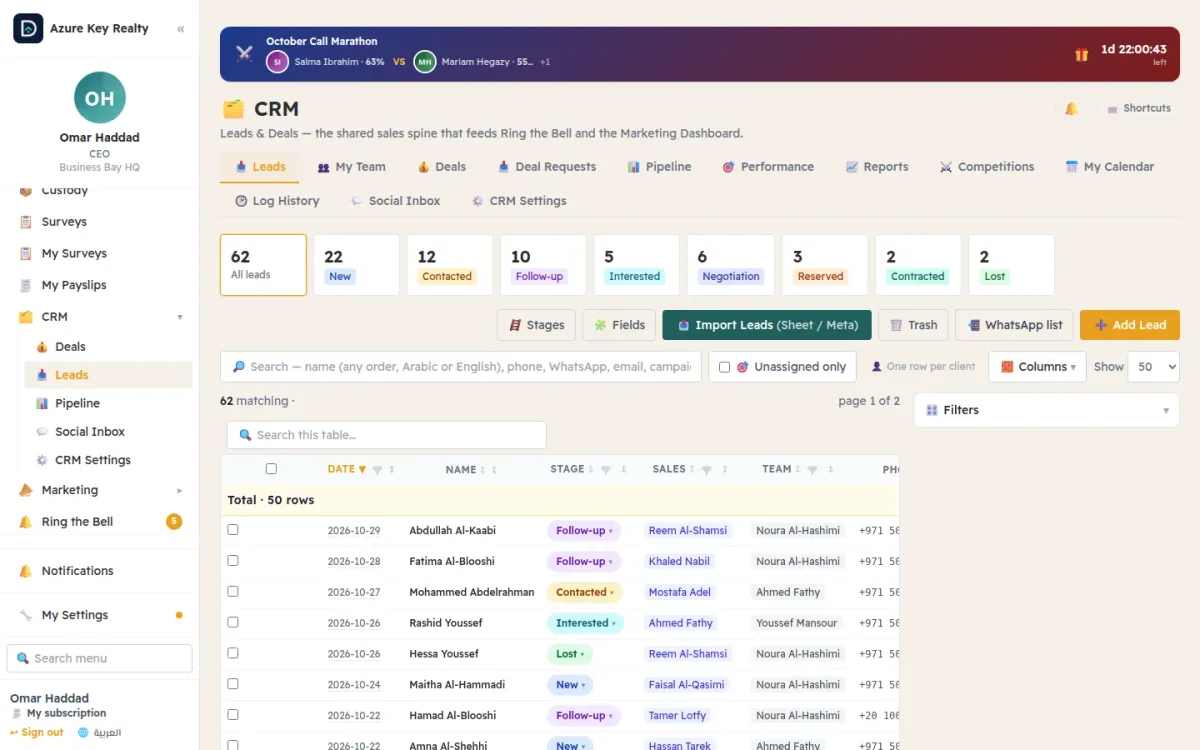
Before relying on any system for this, check that it lets you record the tag and filter or report by it. Our guide to a real estate CRM comparison with 8 checks lists what to verify. Dealora, the real estate ERP built and run by Keys of Success, is one option. You can see how it handles clients, developers and projects in one portal, and the Dealora team's own pages cover real estate CRM software for brokerages.
When one buyer is both
Many buyers are mixed: a family that will live in the unit for five years and sell, or a buyer who upgrades and rents out the old home. Tag the main motive first. Pitch to that motive, and answer the second motive only when the buyer raises it. If you try to serve both from the first call, the message gets vague and the shortlist grows.
A tag can also change. A lead tagged end user who starts asking about resale and exit costs has moved, so update the record and the follow-up. Managers can then see, in the real estate sales pipeline with stages and time limits, which type is stuck where.
A practical next step
This week, take your last 20 closed and lost leads and mark each one investor, end user or mixed from the notes and call memory. Compare where each type was lost, then write the first-call questions and the two follow-up rules into your CRM process. If you want the tagging built into your sales workflow, talk to the Keys of Success team.
Sources
Frequently asked
What is the difference between a property investor and an end user?
An investor buys a property to earn from it, through rent or a later sale, so yield, payment plan and exit matter most. An end user buys to live there, so layout, location, schools, commute and handover date matter most. The same unit can suit both, but the pitch differs.
How can a broker tell whether a buyer is an investor or an end user?
Ask what the property is for, how long they plan to hold it, and whether they will live in it. Investors talk about down payment, installments, rent and resale. End users talk about rooms, school, commute and moving date. Record the answer in the CRM.
Which payment plan suits an investor in Egypt?
Investors who want to stretch their capital often look at extended plans, commonly a 5-10% down payment, up to 10 years and a first payment deferred by 1-2 years. Salaried end users usually prefer standard quarterly plans over 5-8 years. Terms differ by developer, so always confirm them.
Why does resale matter more to investors?
An investor's return depends on selling or renting out the unit later. In Egypt, resale sellers usually ask for cash or a large upfront payment while developers offer long installments, so resale is harder. The seller also pays a 2.5% disposal tax. An end user rarely plans to sell.
What Dubai fees should I explain to a buyer?
Explain the 4% Dubai Land Department registration fee, usually paid at Oqood registration for off-plan and not charged again at title deed. Add the trustee office fee of AED 4,000 for sales of AED 500,000 or more (AED 2,000 below that) plus 5% VAT, and 0.25% of the loan for mortgage registration.
Can one buyer be both an investor and an end user?
Yes. A buyer may plan to live in the unit for some years and sell later, or rent out the first home after upgrading. Tag the main motive and add the secondary one in a note, then pitch the main motive first and answer the second when it comes up.
Related

Read next
- Software for Dubai Property Agencies: 7 Tests Before You Buy A Dubai-specific checklist for choosing agency software: seven tests on your own client list, developer data,
- What Is Dealora? A Plain Guide to the Real Estate Portal Dealora is the AI-powered real estate ERP built and run by Keys of Success. Here is who it is for, what each m
- Real Estate Drip Campaign: Build a Follow-Up Sequence A step-by-step build of a real estate drip campaign for new property leads: the trigger, five messages over 14
- How to Get Real Estate Referrals: A Post-Closing Routine Referrals come from a routine, not a favor. Tag every closed deal, schedule follow-ups after handover, ask at